Dear young friend,
I am writing to you in the middle of a rather bleak hour. The Election Commission, the referee of our democracy, finds its neutrality questioned as perhaps never before. (And for good reason, one must add, but read closely and make up your own mind).
Much of our television news has degenerated into a nightly spectacle of crude tribalism, where the loudest voice passes for the truth, and a lot of heat is generated but little light. Where people talk past each other as if speaking in different, violent languages.
Hard and uncomfortable questions are being asked of the judiciary itself—the institution to which we decided to dedicate our lives and whose senior members we put up on a pedestal, but now compelled to question.
And, let’s not forget, speech – the very oxygen of a republic – is too often met with an FIR rather than an argument.
Freedom of speech is theory; a lack of freedom after speech is reality.
I am writing this to the law student, young lawyer, judiciary aspirant who sits up late with a bare act and wonders whether any of it still matters, and also to the young lawyer who has just watched a matter – bafflingly – go a way it should not have gone, and who is now picking up his or her jaw from the floor where it dropped.
You are not wrong to feel unsettled. When faith in our institutions fractures like this, first shock, and then a cynicism sets in. A cynicism that nothing works anymore and all is broken. Add to it the disturbing track record of our profession in rewarding privilege and heredity more than anything else.
But I want to tell you something that I have learned from life so far : cynicism is easy, but competence and courage are rare. Anyone can despair and criticise and write a social media post. Very few can stand up in a courtroom and make the law do what it promises to do.
Our Constitution does not enforce itself. Its words do nothing on their own. It lives only when someone insists – with research (and hopefully not just ChatGPT), with reason, and with courage – that it be read and applied as it was meant to be read and applied. It has to live and persist in our hearts before it lives-on around us.
Remember that our own constitutional history has had its dark hours. In ADM Jabalpur, at the height of the Emergency (Read India After Gandhi by Guha), the Court crushed human rights by holding that the right to life itself could be suspended during a state of emergency. But even in that darkest of hours, one judge, Justice H.R. Khanna, dissented, and it cost him the office of Chief Justice. For four decades, his dissent was a single flicker of flame in a very dark room. Then, in Puttaswamy, of course, the Supreme Court finally said what he had said alone: that he had been right all along. Vindication came late, but it came.
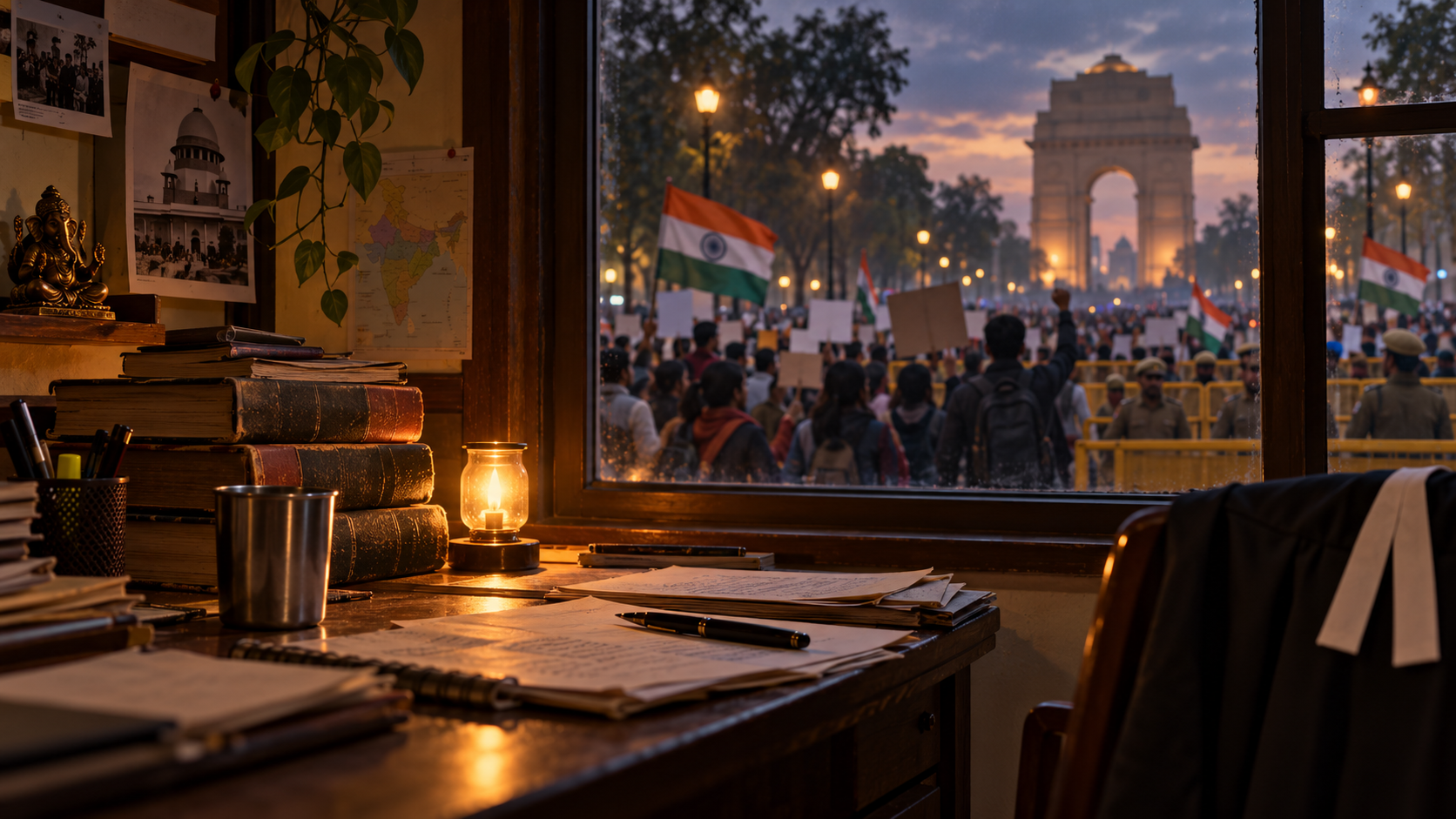
That is how the rule of law survives, across cultures and across histories. Not because the storm never comes, but because someone keeps the flame cupped in their hands until it passes.
This flame is the Rule of Law and the Constitution.
On some mornings, the rule of law will look to you like a candle in a storm. On those mornings, remember that a lawyer’s job is not to curse the wind and rail against it on X or Instagram. It is to protect the flame. And we protect it in unglamorous and more concrete ways: by reading, by researching, by hearing the opposing argument, by arguing, and, whatever the result, by coming back the next day with even greater grit and scholarship.
So here is what I would ask of you.
Begin with the foundations. Before you chase the latest judgment trending on your timeline, sit with the basic textbooks and read them slowly, and more than once. Don’t just watch a reel on a subject. Go back to the giants. Glanville Austin, D.D. Basu, M.P. Jain (and, if possible, Seervai) on the Constitution. Glanville Williams, K.D. Gaur and Pillai on the principles of criminal law. Kelkar on Criminal Procedure. Avtar Singh and Takwani on civil and administrative law.
Remember, case law changes with the season, but First Principles and concepts are what let you see clearly even—and especially—when a new judgment has got something wrong. (which it often does). A lawyer who knows only the latest case is superficial, always uncertain, and subject to the whims of the next judgment. But once your anchor and foundations are firm and run deep, read the judgments themselves, in full and not merely in headnotes, including the dissents, and do it in a chronological fashion, if possible (to see how the law evolved or meandered). Today’s dissent is very often tomorrow’s law.
Then learn, deeply, the law where liberty is, perhaps, under the greatest pressure today.
Learn the law of free speech : what Article 19 truly permits, and what it does not. Learn why Shreya Singhal struck down Section 66A, and why people continued to be booked under it for years afterwards, in one form or another, through clever use of the IPC/BNS.
Learn the law on internet shutdowns, from Anuradha Bhasin onwards, so that you can ask the questions the State must answer: Is the order published? Is it necessary? Is it proportionate?
Learn information technology law, especially the machinery of blocking and takedown, because the public square has moved online—and so has its blatant censorship.
Master the law of bail and remand. This is where the citizen meets and feels the brute power of the State most directly. Most liberty is not won or lost before Constitution Benches or larger Benches where arcane questions of law are decided. It is won or lost at a remand hearing in a Magistrate’s court (often on a Sunday before the Duty Magistrate), in a bail application, or in an objection taken at the right moment by a lawyer who knew the law better than the person across the room. Bail is the rule and jail the exception, but that principle survives only if lawyers know it well enough to insist on it. Learn the new Codes thoroughly, and the old case law that still breathes inside them.
Learn the law on unauthorised demolitions. The Supreme Court has now laid down that due process does not stop at the door of a person’s home, and that the State cannot be judge, jury and executioner with a bulldozer. Those safeguards mean little unless young lawyers know them and are willing to enforce them at short notice—for a neighbour or for a client in the neighbourhood.
And study, with a learned and critical eye, the penal statutes that are grossly unfair or disproportionate: offences drafted so vaguely that anyone can be caught by them, reversed burdens of proof, and bail conditions so stringent that the process itself becomes the punishment.
Do not merely learn to navigate these laws or accept them as gospel. Learn the doctrine of proportionality well enough to challenge them, because the law has always been reformed by lawyers who refused to accept that what is written must necessarily be right, and who tested the law against a higher frame of reference: justice, the rule of law, the Constitution, natural law, and fairness, for instance.
Sharpen your craft relentlessly. Be curious. Read a lot. Draft carefully, argue honestly, and prepare as though the whole matter turns on you because, well, it does. Be the best-prepared person in every room you walk into. In difficult times, excellence and commitment to the values of the craft and of advocacy are themselves forms of peaceful resistance. Work on yourself; let your work be your message.
And when the injustice becomes too great, protest. Your knowledge of, respect for, and commitment to the Constitution will tell you what the legal limits of protest are. Scrupulously follow those limits, and urge others to do so too. Read Tolstoy, Gandhi and Martin Luther King Jr.
And do not wait to be senior before you begin. Take up a matter for someone who cannot pay. Answer the call from a frightened family at midnight. Protect someone’s one-room tenement in the East Delhi slums from vindictive demolition simply because they didn’t pay a bribe.
The Constitution is defended in small acts long before it is defended in large ones. And when we take care of the small things, as someone wiser said, the big things will take care of themselves.
Remember, too, that institutions are not buildings. They are people. The courts, the commissions and the newsrooms of the next thirty years will be made up of people your age. They will be made up of you, dear readers. If they are to be better, it will be because people like you chose to become the kind of lawyer—and someday, perhaps, the kind of judge—who makes them better.
The darker and more challenging the hour, the brighter the light of knowledge must be, and the sharper the craft.
The greater your knowledge, the greater the hope for the future.
I have faith in you. Please keep yours.
Yours truly,
Bharat
You may also find interesting: Letters to an Aspiring Judge.


Leave a Reply