Berlin by Jason Lutes (1)
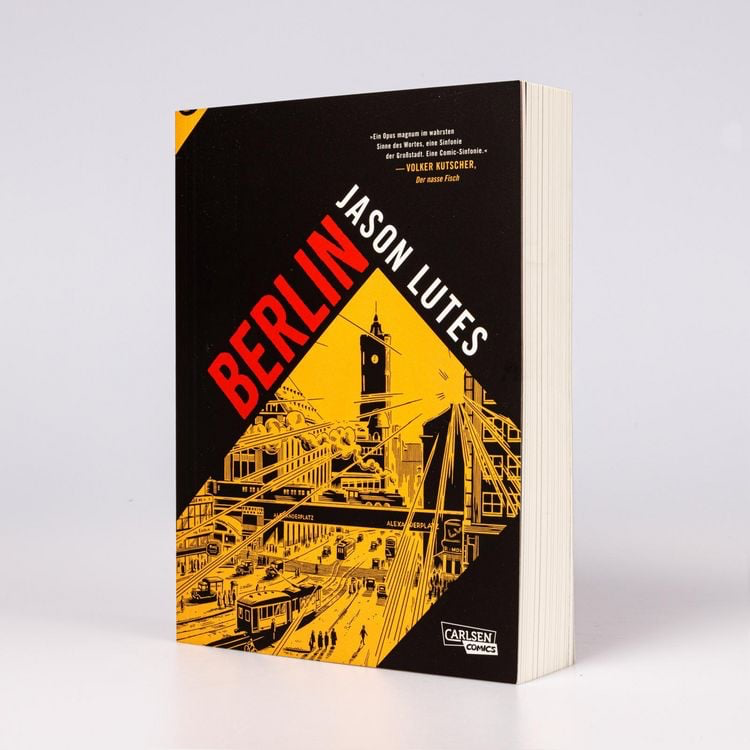
Ahead of a trip to Berlin & Munich in June later this year, I picked this up and it turned out to be exactly the kind of preparation no guidebook could offer.
Lutes apparently spent nearly two decades on this book, and every page shows it. Berlin is a stunning portrait rendered in ink. It’s vivid, immersive, and almost unbearably alive. The Weimar Republic at its most electric and its most fragile: jazz and unemployment, Art, philosophy and street brawls and riots, desire and dread occupying the same crowded streets.
What makes this book truly extraordinary is its sheer intimacy. Lutes gives us ordinary Berliners : a journalist wrestling with his conscience and fighting writer’s block, a student fleeing her middle-class normality, a communist worker who still believes history is on his side, a Jewish family navigating a city that is quietly, then not so quietly, menacingly turning against them, and through these people it tells the story of an entire civilisation in the last warm hours of light before a terrible terrible darkness. You grow attached to these people and they live-on in your memories. That’s the design of the book, and the cruelty of the times.
The Nazis enter the story the way catastrophe usually does: at the margins first, then everywhere all at once. Lutes has left a lot unsaid, but it haunts with its presence. The reader carries the full weight of what is going to happen while the characters, magnificently, do not.
And then the book ends, right before the horrors. That choice is the most devastating thing about it. In the not-saying, Berlin says everything. Some endings work precisely because they refuse to arrive.
Gorgeous is exactly the word. Go to Berlin, and take this with you.
The Infinity Machine by Sebastian Mallaby (Book Review 2)
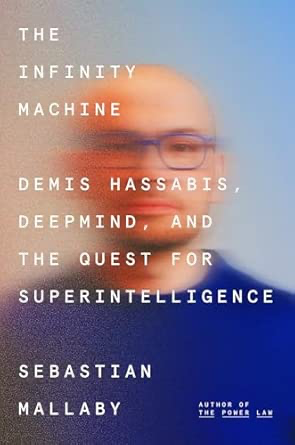
The future is already here, it’s just unevenly distributed. This sentence, borrowed from William Gibson, is a timely reminder for us to take note of how the last few years have changed pretty much everything and poised to do even more. And how we don’t realise it. Reading this book is my attempt to take AI as seriously and as urgently as it merits.
I’ve spent years trying to keep up with technology, not out of any particular aptitude for it (Math remains – quite stubbornly – an enemy to me), but out of a quiet, persistent insecurity: the fear of being left behind, of being rendered irrelevant. So I’ve made it a habit to watch for where the ball is going, and to position myself somewhere near that spot, if not always exactly on it. If you understand it, maybe you can play a part in its shaping — and in how it shapes you and the world around you. Law and Justice, of course, remains the lens with which I also see this, as with everything else.
Coming back to the book, The Infinity Machine is definitely excellent primer on the world of AI, on Large Language Models, Machine Learning, Reinforcement Learning, Neural Networks, AGI, and the contested horizon of super-intelligence, told through the life and work of Demis Hassabis. The guy who created Google DeepMind (Responsible for Alpha Go, solving – through AI – a complex protein folding problem which is a big deal in medical/scientific research and – Google’s answer to GPT and Claude, the Google Gemini, amongst others). His life story is genuinely inspiring, especially when set against the broader cast of characters who populate this particular stage of history including but not limited to Sam Altman. Another consequential (and polarising) figure in today’s time who figures repeatedly.
I needed to understand this world. Not merely to satisfy curiosity, but because understanding it seemed like a precondition for participating in it. And participation matters, because if there is any chance of shaping what AI becomes, rather than simply being shaped by it, that chance belongs to those who are paying close attention. We have all seen the Terminator (or, any AI-gone-rogue movie of your choice).
Most of us would prefer a different ending.
But beyond these science-fiction anxieties lies a more pressing concern. Technology and AI present enormous opportunities and equally enormous risks, for entrenching inequality, enabling oppression, and further hollowing-out of individual dignity and privacy. The lesson of social media, delivered daily through daily IG doom-scrolling, is that even our attention and free-will can be tech-engineered away from us. In this background, the stakes for law, ethics, and Justice are not theoretical or merely an option. They are immediate. Pressing. Urgent.
This is why I read books like this one: to understand the game well enough to contribute something to it; to the slow, often relatively less glamorous work of ensuring that as the world is rebuilt, it is rebuilt a little more fairly and equitably. That not every person is left behind, or treated as an afterthought, or simply discarded. Leibniz dreamed of the best of all possible worlds. We would settle, at this point, for a substantially fairer one. Or at any rate, not being obliterated by it.
The Infinity Machine delivers on the promise of its subject with extraordinary storytelling and solid intellectual weight. It did not disappoint. Strongly recommend this one.
 The Blog of Bharat Chugh
Leave a Reply