“Sunlight is said to be the best of disinfectants.” — Justice Louis D. Brandeis
“Most ignorance is willful ignorance. We don’t know because we don’t want to know.” — James Baldwin
A charge hearing under the Indian Criminal Justice System (“CJS”) is meant to filter-out meritless cases at the very threshold and before a full trial, thus protecting accused persons from baseless prosecutions and focussing the court’s time and resources on more worthy cases.
In practice, however, discharge hearings in India are often reduced to a one-sided farce and a foregone conclusion.
This is because the court, at this stage, ends up scrutinising only the prosecution’s self-chosen/selective/cherry-picked evidence, and the accused is not given an opportunity present any exculpatory material.
This material that the court is deprived-of could be material collected and suppressed by the police, or material in accused’s possession which was never collected during investigation and, consequently, never put before the Court.
Given this, the accused is effectively forced to disprove the prosecution’s case from within the mountain of self‑serving material prosecution has filed, without being able to rely upon or even getting knowledge as to potentially exculpatory documents that are withheld.
Consider a case where CCTV footage from the scene—clearly showing the accused elsewhere at the relevant time—is seized during investigation but not relied upon by the prosecution while filing the charge-sheet. The footage forms part of the police case diary, but since the prosecution chooses not to annex it under Section 173(5) CrPC, it never reaches the court’s gaze at the discharge stage. The Court takes cognizance mechanically and does not order further investigation either (which it should – in such cases). The accused, barred by precedent from producing defence material, is left powerless to point to evidence that conclusively negates presence, motive, or opportunity. The court, in turn, is asked to decide whether a trial should proceed while being shown only one half of the investigative truth. The discharge hearing, in such a case, becomes not a filter against unjust prosecution, but a ritual affirmation of it—where exculpatory truth exists, but is rendered legally invisible.
This problem becomes graver in a country like ours where trials typically drag-on for years or even decades, making early dismissal crucial to avoid unnecessary suffering, and to ensure that the process itself doesn’t become the punishment.
But it does, the process is the punishment in India.
Why are we in such a sad state of affairs?
Let me explain.
Statutory Scheme: Sections 173 and 207 CrPC
A quick overview of the law in this regard – first. We’d be referring to provisions in the CrPC for two reasons : 1) the jurisprudence is all based on these; and, 2) there isn’t much change in the new law (BNSS) on these aspects.
So let’s begin.
Sections 227–228 CrPC (for Sessions trials) and their counterparts in Chapter XIX of the CrPC provide the mechanism for charge and discharge. The preliminary hearing that sifts out meritless cases. At this stage, the law provides that the judge must consider the record of the case and documents submitted therewith and hear the accused’s and prosecution’s arguments.
This has effectively meant consideration of record that the prosecution chooses to place before the Court. Nothing more, nothing less.
Section 173(5) CrPC further reveals that the so-called record of the case or, in other words, the police report is constituted of the documents on which the prosecution proposes to rely, and the statements of witnesses whom the prosecution proposes to examine as its witnesses.
So convenient and self-serving, isn’t it?
This effectively confines the material filed by the police/prosecution to only those documents and witness statements that the prosecution wishes to rely on.
And what does the prosecution wish to place reliance on ?
Well, no points for guessing, this is incriminating material, and almost never any material that would help the accused.
Turkeys don’t vote for christmas, do they?
There’s a classic conflict of interest. The objectivity that was expected of the stakeholders and institutions has remained a distant dream.
Be that as it may, the above principle, which is the original sin of the law, sits very uneasy with two fundamental principles that we’ve been taught as students of criminal and constitutional law:
- Firstly, an investigation in a criminal case is a voyage of discovery, with truth being the ultimate quest. With this being the purpose, investigation cannot be one-sided, pro-prosecution (or pro any side) and a collation of only incriminating material. It is supposed to be a search for truth and anything that has any bearing on the charge against the accused, whether for, or against the accused, has to be put before the Court, allowing the court the fullest opportunity to make a wise decision;
- All of these materials have to be shared with the accused too, especially when an individual accused/defence has no investigative apparatus at his/their disposal and no ways to collect material himself. This is crucial. This is also important because the state is not only to prosecute those who’ve committed an offence but also protect those who have been falsely implicated. (A perusal of provisions of the IPC/CrPC would reveal the police is empowered, and I’d say, obligated, to prosecute the complainants also if the complaint is found to be unworthy. Provisions which have been remained dead-letters in the law, unfortunately. I’ve written a lot on this separately).
The statutory scheme is in direct conflict with the above hallowed principles.
But just to Once the charge‑sheet and its annexures are sent to the court, Section 207 CrPC requires the trial court to furnish the accused, free of cost, copies of the police report and all documents submitted to the Magistrate.
Though just to complete the statutory loop, before we get to judicial decisions, unlike Section 173(5), Section 207 CrPC contains no qualifier such as“on which the prosecution proposes to rely or proposes to examine”; it speaks simply of “the documents submitted to the Magistrate”. But the practical result is the same because all that the court has is the self-serving material of the prosecution. To recapitulate material, that the prosecution chooses to place reliance on.
The combined effect of a literal and pedantic reading of Sections 173 and 207, therefore, is that the court’s scrutiny at the charge‐framing stage is confined to incriminating material.
The statute assumes that this is all the information the court needs – but in reality only the police/prosecution’s narrative is before the judge.
If investigators obtain exculpatory statements or documents during investigation but do not forward them to court, the court will not see them – at the charge stage.
So, a discharge hearing becomes a filter that filters nothing.
A hearing which hears only one.
A seeing – of only one side’s case.
And, as a result of this, the accused is deprived of a crucial opportunity to show – at the very outset – that the charge is baseless.
So the statute appears to be clear on this regard : only prosecution material.
But how have the courts looked at this.
Have they breathed life and meaning into the dead-words of a statute, and made it more fair and just.
Well, let’s find out:
Evolution of case-law:
Satish Mehra (1996)
One of the earlier cases on this was Satish Mehra (1996) which is a 2 judge SC decision, the court held:
“If the accused succeeds in producing any reliable material at that stage which might fatally affect even the very sustainability of the case, it is unjust to suggest that no such material shall be looked into by the Court at that stage.”
This was an interesting and important case which effectively held : “an accused can produce reliable evidence at the stage of framing of charge to seek discharge”.
This was a very positive development but, some may argue, a bit too extreme and capable of making the charge/discharge hearing a mini-trial.
It could have laid down a stricter test for what material could be led by the accused at that stage and in not doing so, it opened the door a bit too wide and, in certain cases, made hearings on discharge mini-trials.
So the judiciary had to act to correct what it saw as an aberration.
Om Prakash (2000)
This wide principle sought to be restrained a bit in Om Prakash (2000) (2 Judges SC) which, while recognising the power to look at accused’s material at that stage, sounded a word of caution:
“The language of Section 91 would, no doubt, indicate the width of the powers to be unlimited but the in-built limitation inherent therein takes it colour and shape from the stage or point of time of its exercise, commensurately with the nature of proceedings as also the compulsions of necessity and desirability, to fulfil the task or achieve the object. The question, at the present stage of the proceedings before the Trial Court would be to address itself to find whether there is sufficient ground for proceeding to the next stage against the accused. If the accused could produce any reliable material even at that stage which might totally affect even the very sustainability of the case, a refusal to even look into the materials so produced may result in injustice, apart from averting an exercise in futility at the expense of valuable judicial/public time. It is trite law that the standard of proof normally adhered to at the final stage is not to be insisted upon at the stage where the consideration is to be confined to find out a prima facie case and decide whether it is necessary to proceed to the next stage of framing the charges and making the accused to stand trial for the same. This Court has already cautioned against undertaking a roving enquiry into the pros and cons of the case by weighing the evidence or collecting materials, as if during the course or after trial vide Union of India vs Prafulla Kumar Samal & Anr. [(1979) 3 SCC 4]. Ultimately, this would always depend upon the facts of each case and it would be difficult to lay down a rule of universal application and for all times. The fact that in one case the Court thought fit to exercise such powers is no compelling circumstance to do so in all and every case before it, as a matter of course and for the mere asking.”
Some sort of a balance was sought to be introduced by this judgment but, once again, without a very clear bright-line test on what kind of material originating from the accused could be permitted, and what not.
Debendra Nath Padhi (2005)
The issue next comes up before the SC in the famous (or notorious) Debendra Nath Padhi case (2005 – 3 judges) where the Court did two things:
- Explicitly overruled Satish Mehra; (and called Om Prakash observations above mere obiter); and
- Laid down in Paras 8, 18 and 25, the following:
- Para 8 : “No provision in the Code grants to the accused any right to file any material or document at the stage of framing of charge. That right is granted only at the stage of the trial.”
- Para 18 : “At the stage of framing of charge hearing the submissions of the accused has to be confined to the material produced by the police.”
- Para 25 : “Insofar as the accused is concerned, his entitlement to seek order under Section 91 would ordinarily not come till the stage of defence”
- Now, you’d notice that para 8 and 18 observations are quite clear and categorical.
- Para 25, on the other hand, subtly uses an expression “ordinarily”.
- This is – ordinarily – a recipe for disaster and uncertainty, and it has turned out to be as such.
- The expression “ordinarily” was not qualified or explained as to in what cases the accused can press Section 91 in action even at that stage.
- Or a clarification that when the judgment says : ordinarily the entitlement would arise at defence stage only means, in certain cases, it can arise even during the examination of prosecution witnesses, for instance, to confront some witnesses while they are being cross-examined (to prevent the need to recall them again later after discovery of material at DE stage);
- The judgment doesn’t clarify any of these things.
- And given the extremely absolute and sweeping nature of the prohibition, this expression “ordinarily” would used, more than a decade later in another judgment we’d came to, to carve out an exception – even at the stage of charge.
- The judgment failed to make a crucial distinction. The distinction was : accused’s material i.e allowing accused to file his own material at that stage (which is, concededly, against the language of the statute), and, the category of materials which are collected by the police but withheld, suppressed.
- It ought to have made a distinction and while, probably, closing the doors to some extent on the former, it ought to have provided for some carve-out for the latter.
- This failure to make a distinction (and failure by subsequent judgments to fill this lacunae themselves) has led to Padhi being the single reason why most charge hearings, across the country, have become exercises in futility and caused incalculable damage to lacs of people who must have had to face trial, despite there being clear material to exonerate them – at that stage itself.
- Further, the total non-consideration with the issue of fairness of investigations, complete disclosure, and court’s right to be informed of both sides of the coin at that stage, were totally avoided. A pedantic analysis of the legal position, shorn of ground realities was conducted.
- The Court in Para 21 and 29 did speak about powers of the High Court, while exercising jurisdiction u/s 482 of the CrPC, to look into some material even beyond the chargesheet.
- “where forensic exigencies and formidable compulsions justify such a course.” and “We hasten to add even in such exceptional cases the High Court can look into only those documents which are unimpeachable and can be legally translated into relevant evidence”
- Discussing earlier precedent on this aspect, the Court further said : “It is evident from the above that this Court was considering the rare and exceptional cases where the High Court may consider unimpeachable evidence while exercising jurisdiction for quashing under Section 482 of the Code. In the present case, however, the question involved is not about the exercise of jurisdiction under Section 482 of the Code where along with the petition the accused may file unimpeachable evidence of sterling quality and on that basis seek quashing, but is about the right claimed by the accused to produce material at the stage of framing of charge.”
- This, again, was problematic for a number of reasons. If both Section 482 CrPC and discharge hearing are threshold hearings, then:
- Why this disparity?;
- And what the judgments leaves unanswered as a question is : what kind of material can the HC or SC can then look into? What is an ‘exceptional case’. What‘forensic exigencies and formidable compulsions’ justify this? What would be unimpeachable evidence of sterling quality?;
- This is important because this unimpeachable evidence of sterling quality is a phrase that would make a come back in court judgments, with many referring to it, but everyone failing to define it with any sort of precision.
- Also, this seemed a little unfair given the fact that High Courts seldom have the luxury of time of hearing quashing petitions at length, in today’s day and age and are often inundated with bail applications, suspension applications, quashing of FIRs on the basis of compromise (another day, on this anomaly also!)
Anyway, we march on – on the journey on this count. The next stop is Shakuntala.
Shakuntala v. State of Delhi (2007, Single Judge, DHC).
This concerned a case where the focus started coming, and rightly so, to disclosure. This was a case where some statements recorded u/s 161 of the CrPC were withheld and not made a part of the chargesheet and the Court ordered their production, at the stage of charge itself.
Para 4 of the judgment is instructive and is being reproduced in entirety:
Para 4 reads:
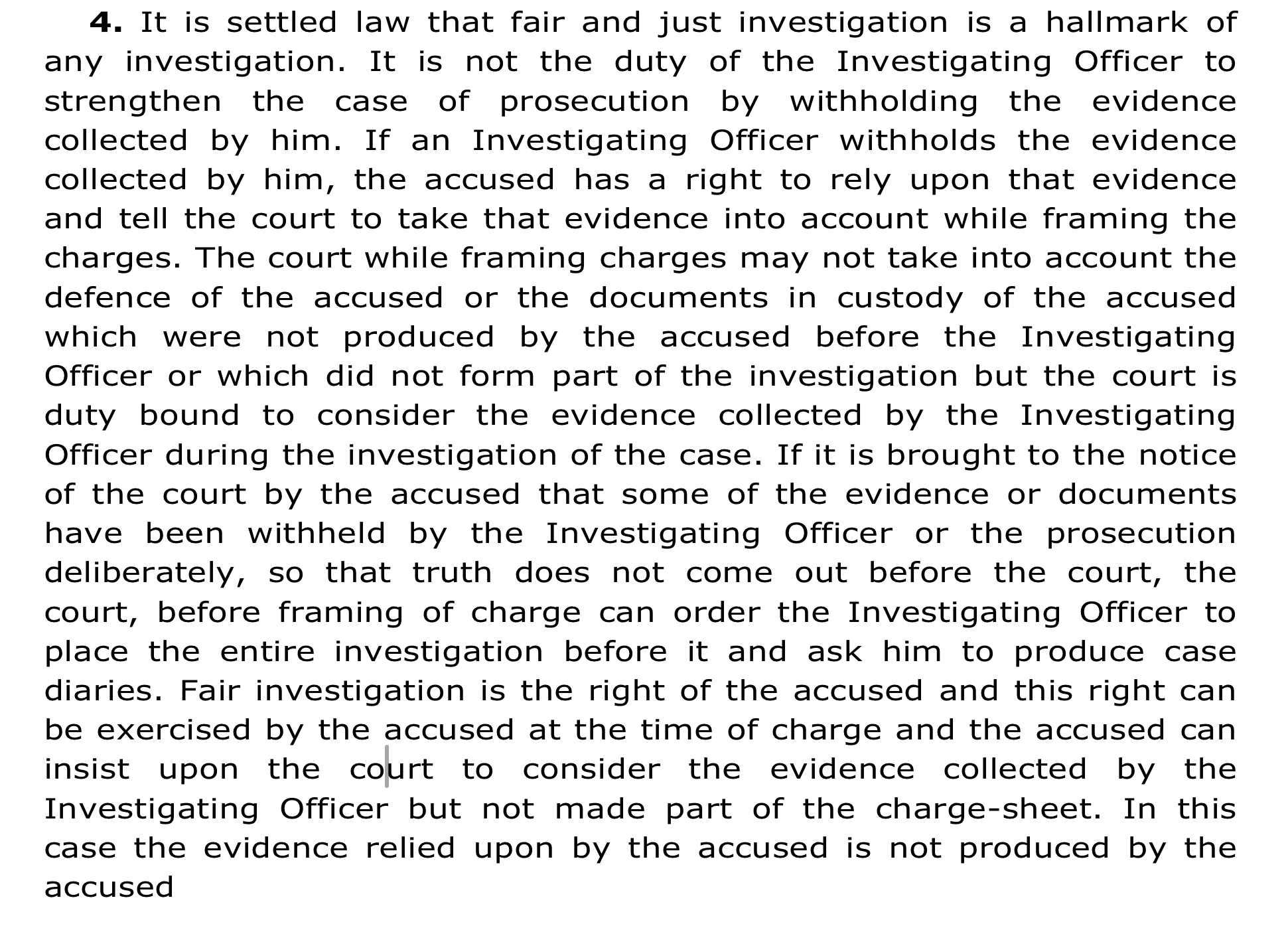
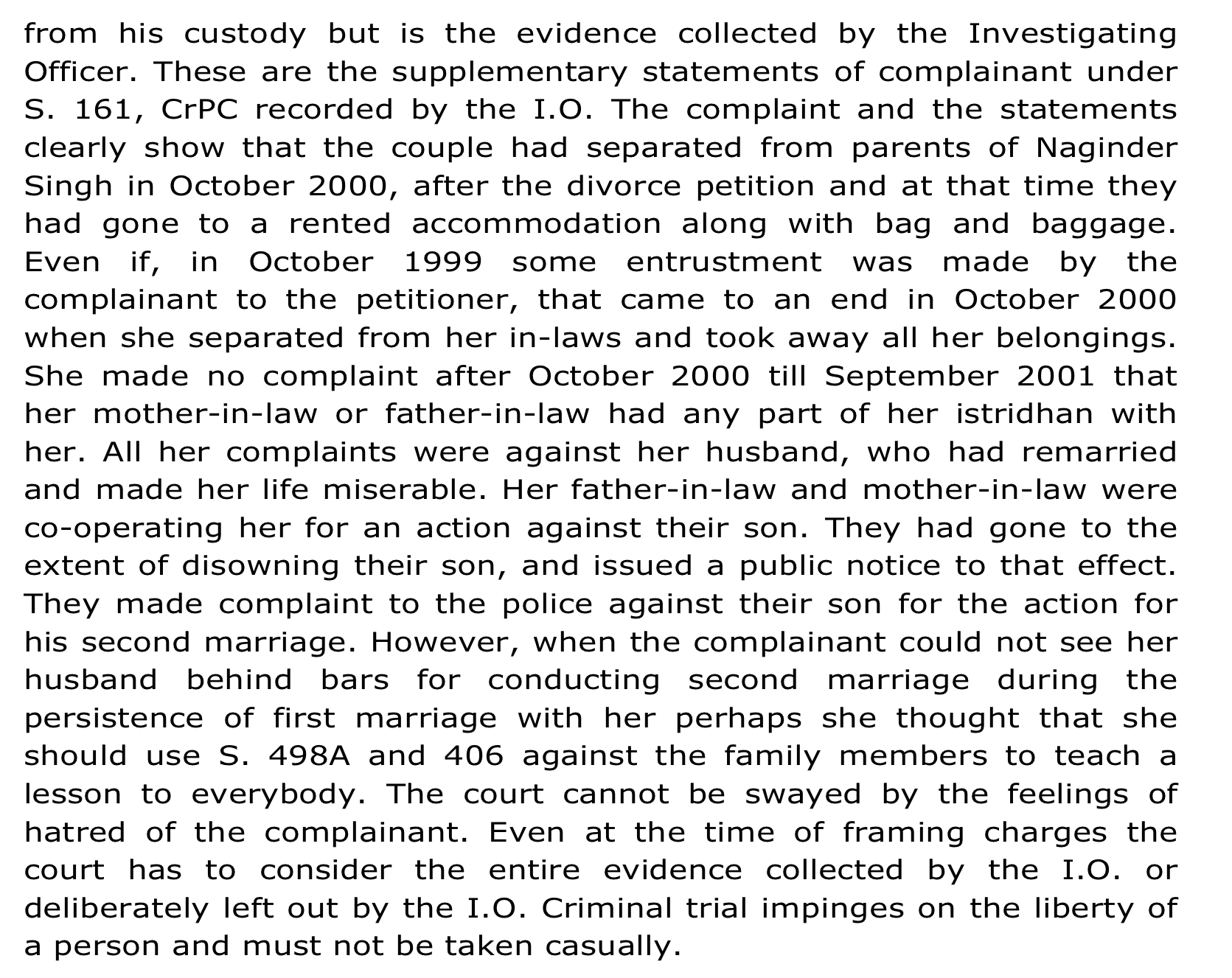
This was important. Though, what possibly takes away the precedential value of this judgment is the fact that earlier judgments including Padhi are not even noted or argued, let alone considered.
This is a bane of some judicial decisions in India where benches – sometimes – do not note the prevailing law of bigger or even co-ordinate benches and go on to lay down a legal principle, as it it is the first time that principle is being laid down, completely ignoring precedent. This may be for a number of reasons and it’s not the purpose of this column to go into those but what it undoubtedly does is : it leads to an extraordinary amount of confusion on what the law really is, and that’s supremely problematic when we also note : ignorance of law is not an excuse!
Anyway, let’s move on to the next exhibit in this journey:
Rukmini Narvekar (2008) Supreme Court:
At the very outset, it must be noted that this was a case concerning the scope of jurisdiction of the High Court while exercising powers u/s 482 of the CrPC but what J. Katju said at Para 22 is instructive:
Para 22 : “Thus in our opinion, while it is true that ordinarily defence material cannot be looked into by the court while framing of the charge in view of D.N. Padhi case®,, there may be some very rare and exceptional cases where some defence material when shown to the trial court would convincingly demonstrate that the prosecution version is totally absurd or preposterous, and in such very rare cases the defence material can be looked into by the court at the time of framing of the charges or taking cognizance.”
and Para 23:
“23. We agree with Shri Lalit that in some very rare cases the court is justified in looking into the material produced by the defence at the time of framing of the charges, if such material convincingly establishes that the whole prosecution version is totally absurd, preposterous or concocted.”
Though, one must add that while the final result of the case was upheld in the concurring judgment, this legal observation was doubted by the other Ld. Judge on the bench, basis Padhi, in the following words:
“8. The larger Bench (In Padhi) did not leave any scope for a different interpretation of the provisions of Section 227 as is now being made. Incidentally, the very same arguments which have been advanced by Mr. Lalit before us on behalf of the accused, were also advanced by learned counsel before the larger Bench and the same were negated as far as Section 227 Cr.P.C. is concerned. However, in paragraphs 21 and 29 of the judgment the larger Bench did indicate that the width of the powers of the High Court under Section 482 Cr.P.C. and Article 226 of the Constitution is unlimited whereunder in the interest of justice the High Court could make such order as may be required to secure the ends of justice and to prevent abuse of the process of any court.”
and
“9. In my view, therefore, there is no scope for the accused to produce any evidence in support of the submissions made on his behalf at the stage of framing of charge and only such material as are indicated in Section 227 Cr.P.C. can be taken into consideration by the learned magistrate at that stage. However, in a proceeding taken therefrom under Section 482 Cr.P.C. the Court is free to consider material that may be produced on behalf of the accused to arrive at a decision whether the charge as framed could be maintained. This, in my view, appears to be the intention of the legislature in wording Sections 227 and 228 the way in which they have been worded and as explained in Debendra Nath Padhi‘s case (supra) by the larger Bench to which the very same question had been referred.“
The precedential value of the decision, already weak from the start, gets even more diminished.
Manu Sharma (2010) SC
The next judgment of consequence is Manu Sharma (2010).
What happened in this case?
This is the infamous Jessica Lal Murder case. The accused’s appeal challenged his conviction, alleging, inter alia, investigative lapses and nondisclosure of certain reports.
The Supreme Court took the opportunity to wax eloquent about the ethical and legal duties of prosecutors and investigators vis-à-vis evidence – both inculpatory and exculpatory and held all should be disclosed.
This judgment was important for the principle that it stood for.
Of course, it halved its value and impact by applying the prejudice test and by holding that, in the ultimate analysis, though there was indeed a non-disclosure but that didn’t make a difference to the outcome of the case given the overwhelming evidence otherwise available against the accused.
Also, it failed to determine the stages of disclosure, which has turned out to be the biggest problem and bone of contention.
V.K.Sasikala (2012) SC
The next case of consequence in this saga is V.K.Sasikala (2012).
This case concerned, accused seeking to bring on record certain documents Mid-Trial (after PWs examined, 313 partly done).
These documents were filed before the court by the IO/prosecution but never supplied to the accused, and never relied upon in prosecution testimony (in legal ease, never marked ‘exhibits’).
The Court upheld the right of the accused to copies of these documents too, despite the advanced stage of the case.
But this wasn’t a case on the question of documents seized by the Investigating officer and wrongfully withheld, therefore, it is not a precedent on this question specifically.
And the court recognises this in Para 17 when it says: “However, it is not impossible to visualise a situation whether the investigating officer ignores the part of the seized documents which favour the accused and forwards to the court only those documents which support the prosecution. If such a situation is pointed by the accused and such documents have, in fact, been forwarded to the court would it not be the duty of the court to make available such documents to the accused regardless of the fact whether the same may not have been marked and exhibited by the prosecution?”
Great observations, right? And great identification of the legal issue.
But, and there’s a big one, right after noting this, in an anti-climax of sorts, the court then says – this is not the question that arises in this case.
The case, as I just told you, concerned documents filed in court but not relied upon and not supplied to the accused.
This was, therefore, an easier case to answer.
The impact it unfortunately had was be to make police more circumspect in what documents are filed before the Court, and to not file those documents in the first place before the court, with a view to overcome or bypass this ruling.
So nothing really achieved here of consequence, except, of course, some rhetorical grand-standing about the importance of disclosure.
Next important ruling was Rajiv Thapar, but we’ll make only a quick stop here since the decision concerned itself with what documents could be looked into when the court is exercising jurisdiction u/s 482 of the CrPC.
On that limited aspect, the court said that the High Court can look into material of “sterling quality” which was “unimpeachable” in nature, and presented a complete answer to the prosecution. This case does not concern itself with scope of a discharge hearing.
Next important judgment was : Nithya Dharmananda (2018 SC).
Nithya Dharmananda (2018 SC).
What happened in this case was that a few important statements of witnesses u/s 161 of the CrPC were recorded by the IO but not made a part of the police report. They were important statements. The Court was, therefore, and for good reason, unhappy with this and made some good observations.
Nitya Dharmananda is a landmark and important in that it authoritatively introduced a crack in the Padhi wall, while still maintaining the wall. (and it couldn’t have broken through the wall given Padhi was 3 judges and Nitya 2 judges)
Further, it explicitly uses “ordinarily” (occurring in Padhi) as a qualifier, highlighting that the bar to consider the defence material at the stage of charge is not absolute.
The decision empowered courts to intervene in cases of apparent prosecutorial suppression of evidence by using Section 91 of the CrPC.
It resonates with Manu Sharma’s ethos of disclosure & Rukmini Narvekar’s ethos (ensuring absurd or groundless cases don’t proceed) and gives trial judges (not just High Courts in a quashing petition) a tiny window to ensure fairness.
In practice, however, courts remained cautious even post-Nitya.
Also, there was a big problem, how do you know IO has suppressed something, when the IO has actually suppressed it? This is in the realm of unknown, to put it more philosophically.
You won’t know what the IO has concealed because, as is clear, the IO has concealed it. And concealed it well.
The Court did not try solving this conundrum and did not – it seems – think on these lines.
Therefore, while available in law, Section 91 invocations remained an extreme rarity and only in cases where accused is able to demonstrate that IO has something which is crucial and sterling.
Some accused persons used this to refer to evidentiary material that the accused placed with the Investigating Officer formally in the course of investigation and can prove the same.
Two paragraphs from Nitya deserve to be reproduced verbatim and are – till date – the only protection available to the accused w.r.t disclosure at the stage of charge:
Para 5 : “It is settled law that at the stage of framing of charge, the accused cannot ordinarily invoke Section 91. However, the court being under the obligation to impart justice and to uphold the law, is not debarred from exercising its power, if the interest of justice in a given case so require, even if the accused may have no right to invoke Section 91. To exercise this power, the court is to be satisfied that the material available with the investigator, not made part of the chargesheet, has crucial bearing on the issue of framing of charge.”
Para 8 further notes : “Thus, it is clear that while ordinarily the Court has to proceed on the basis of material produced with the charge-sheet for dealing with the issue of charge but if the court is satisfied that there is material of sterling quality which has been withheld by the investigator/prosecutor, the court is not debarred from summoning or relying upon the same even if such document is not a part of the charge-sheet. It does not mean that the defence has a right to invoke Section 91 CrPC dehors the satisfaction of the court, at the stage of charge”
Then comes Ashok Kumar Aggarwal (2021 – Delhi High Court). The Court, noting Padhi and Nitya permitted a Section 91 invocation and material outside of the charge sheet to be looked-into, given the criticality of the material to the outcome of that case.
The specific material looked into this case concerned the very jurisdiction of the Special Court, Prevention of Corruption Act, and a doubt on the very foundational fact of : whether the accused was a public servant at all, and, if not, there could not be a trial by the Special Court.
Despite these somewhat facially positive developments, problems remained. The Accused had no means of knowing that the IO has concealed imperative exculpatory evidence.
A way around this was : a right to inspection of the records to find out if something’s been concealed.
This is a right well known pretty much all over the world.
CBI Manual also interestingly permits an accused to exercise this right.
In this background, we get to another decision of some consequence.
In Re : Criminal Trials Guidelines (Supreme Court, 2021) 3 Judges & Draft Rules.
This is the background in which we come to this 2021 decision.
Picture this, Supreme Court is hearing a matter and generally debating on large scale criminal law/justice reforms. They appoint amici and then, given the inconsistencies in practices across states, and gaps, etc, they effectively say : That High Courts should frame rules on the Criminal Side governing the process and progress of investigations and trials. To aid the High Courts they come up with Draft Rules, which could be adopted by the High Courts.
One of such rules is important here.
Rule 4 of the draft rules.
This is where the concept of ‘list of un-relied upon documents’ has surfaced for the first time.
The Rule is as follows:
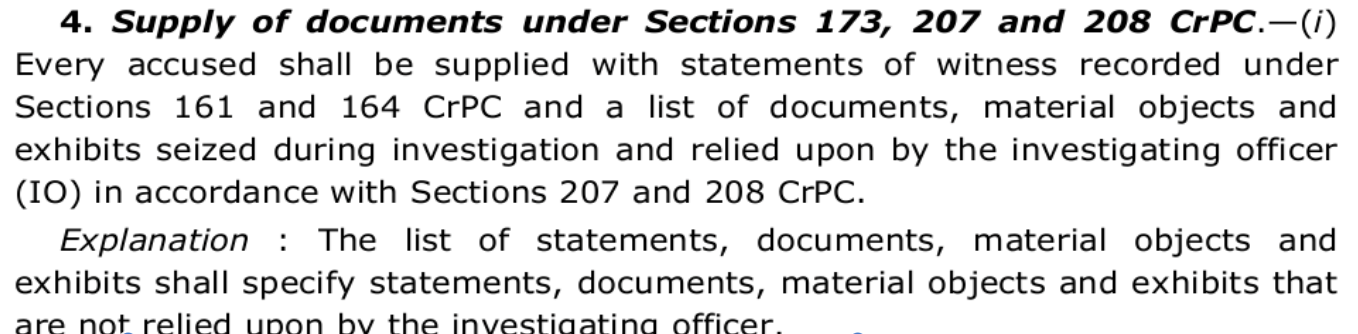
Clearly, there are 3 parts to it:
- There has to be a list;
- And the list has to be provided; and
- the list has to mention unrelied upon documents also.
This is clear enough.
But for some reason, courts started drawing a distinction between the list and documents/papers, which is – with great respect – bizarre.
The Rule says that a list has to be provided which is a list of both relied upon and unrelied upon documents.
This is at the stage of Section 207 of the CrPC, i.e before charge.
The draft rule doesn’t say anything as to whether the documents have to be provided or not.
But the courts started reading this ruling to mean : that only a list of unrelied upon documents would be provided but not the documents themselves, presumably, going back to Section 173 and 207 and their conventional (and I’d argue – rather pedantic) reading.
This is problematic.
Effectively, the courts only entitled the accused only to the list, but then what’s the purpose achieved?
Well, not for arguments on charge because the documents themselves in-specie cannot be called. So, coming back to the original argument, the charge hearing remained somewhat confined and one-sided but there was a possibility in future to summon these documents and argue.
This is strange and the central problem with these judgments.
Why would the prosecution not put these documents before the Court especially when they already have them?
It doesn’t delay matters since the police already has it and ought to have verified their authenticity too.
What prejudice will it cause to the prosecution if any at all, if these are provided to the accused at that stage itself. They may even help the accused to show to the court, at that stage itself, and from within the prosecution material, that the case is a hopeless one.
Prosecution surely can’t challenge the veracity and provenance of this material, usually, since they have only collected it and must have or – at any rate – ought to have, verified it. And if that’s the case, why deprive the court of an opportunity of looking into this, while deciding charge or discharge.
So you have a list, but what do you do with it? Well, nothing at all.
Also, the decision in 2021 In re, ought to have said something on disclosure and duty to place all material before the Court. But, probably, the ghost of Padhi continued to haunt it and it stopped short, or this concern was never raised, as is often the case when ad-hoc policy is made in judicial decisions which require a lot more deliberation than what court hearings permit, given time and stakeholder representation concerns.
Anyway, the next decision of consequence is CBI v. Inx Media (2021) DHC
CBI v. Inx Media (2021) HC
The principles above were tested in the proceedings arising from the INX Media corruption and money-laundering case(involving former Finance Minister & others).
In this case, investigation agencies (CBI and ED) had seized voluminous records. When the matter proceeded toward framing of charges, the accused sought access to materials that the agencies had not relied upon in their charge-sheets/complaints.
A Special CBI Court in Delhi directed that the accused be given certain documents, and, at least, a list of all unrelied documents was provided (in electronic form) in April 2021 .
The CBI/ED, however, resisted full disclosure and approached the High Court.
In November 2021, the Delhi High Court ruled that the investigating agencies cannot withhold documents seized during the investigation from the accused, even if not relied upon, once the case reaches the stage of charge .
The High Court, effectively, affirmed the trial court’s orders that the accused are entitled to inspect the un-relied materials kept in the agency’s “malkhana” (storage) and obtain copies, if necessary.
The rationale was that an accused must have a fair opportunity to defend himself, especially in a case where special statutes (like the PMLA) impose stringent burdens.
The prosecution cannot selectively choose evidence and bury the rest.
This Delhi HC decision explicitly drew from the Supreme Court’s 2021 guidelines and the trend of ensuring fair disclosure.
Importantly, the “stage” at which the accused and others sought these documents was prior to framing of charge.
The type of documents in question included things like: case diaries, witness statements recorded by the ED, bank records, and other papers gathered during raids/searches which were not filed as part of the charge-sheet/complaint.
The CBI v. INX Media matter ultimately went to the Supreme Court, which in July 2023 refused to interfere with the High Court’s pro-disclosure stance .
The Supreme Court dismissed CBI’s plea against supplying the documents, effectively upholding that order. (But since SLP was dismissed, it does not make a Supreme Court decision for the purposes of precedential value).
Thus, by 2023, it stood confirmed that even at the charge stage, a court can direct – and an accused can obtain – inspection and even copies of unrelied-upon documents that were seized or formed part of the investigative record, in order to ensure a fair trial.
The INX Media litigation is a concrete example of mitigation of the strict rigours of Padhi and was a progressive decision.
Manoj (2022) & Ponnusamy (2022) SC.
- In Manoj & Ors. v. State of M.P. (2022), a capital punishment case, a bench led by Justice U.U. Lalit stressed the importance of procedural fairness in all criminal trials.
- The Court expressly directed that at the time of framing charges, the prosecution must provide a list of all statements, documents, material objects, and exhibits collected during investigation but not relied upon by the IO.
- This was nothing new as earlier judgments had already laid down this principle.
- This reiteration was in line with the April 2021 guidelines.
- The context in this particular case was that some of the appellants (facing death sentences) argued they could not effectively appeal their conviction/sentence without knowing the full scope of the evidence gathered.
- By affirming the obligation to furnish the “list of un-relied documents” at the charge stage, the court in Manoj reinforced that this is an immediate right – not something that can be deferred until later in trial.
- The Court in Manoj treated such disclosure as part and parcel of Article 21’s guarantee of a fair trial, thereby giving the 2021 Draft Rule 4 (on supply of lists) a de facto binding effect even before formal adoption.
- Para 209 of Manoj reads : ““209. In view of the above discussion, this Court holds that the prosecution, in the interests of fairness, should as a matter of rule, in all criminal trials, comply with the above rule, and furnish the list of statements, documents, material objects and exhibits which are not relied upon by the investigating officer. The presiding officers of courts in criminal trials shall ensure compliance with such rules.”
- Importantly, Manoj did not concern itself with the right of inspection and production of documents themselves.
- This was simple because the case concerned a post-conviction appeal and alleged non-disclosure during trial, therefore, did not deal with the issue of stage of disclosure at all.
- Then comes, P. Ponnusamy v. State of Tamil Nadu (2022) – This case (decision dated 8 Nov 2022) was heard by a three-judge bench and resulted in a 2:1 majority opinion.
- It addressed a scenario where the accused (on trial for murder and sentenced to death) had, even at the appellate stage, sought certain documents from the prosecution.
- Justice Bela Trivedi (dissenting) was reluctant to extend any new rights at the appellate stage before the High Court, especially since the Draft Rules were not yet formally notified .
- However, Chief Justice Lalit and Justice S. Ravindra Bhat formed the majority.
- They disagreed with the narrow view, holding that the accused’s right to disclosure of investigation materials does not depend on the formal adoption of the 2021 Draft Rules. This was useful.
- The majority unequivocally declared that an accused is entitled to receive a list of all statements, documents, and material in the prosecution’s possession, even if the new rules have not been brought into force by local amendments . This was important. There is no reason as to why an accused in a state where draft rules have not been framed should be prejudiced, merely because the High Court chooses not to make and notify these rules.
- They emphasized that a State’s delay in implementing the Supreme Court’s directions “cannot prejudice the right of an accused” to this information .
- Importantly and – somewhat disappointingly – Ponnusamy also touched on the timing: the majority essentially concurred that no right to actual copies of unrelied documents arises at the framing of charge (consistent with Padhi/Nitya).
- However, Justice Bhat’s concurring views (in line with earlier Delhi HC decisions) suggested that the right to apply for such documents would “trigger” once the trial begins – i.e. during the stage of evidence – and that a trial court could consider the relevance of the requested materials at that point .
- This, in my opinion, unduly restricted the scope and diluted the hard-won protections and exceptions secured in Nitya and CBI v. Inx Media. There was little reason to get into this discussion. It also tried to reinstate firmly the classic Padhi position.
- The net result of Ponnusamy was an affirmation that the accused must at be informed of all unrelied evidence (list supply is mandatory), and that courts should facilitate access to relevant defense-favouring material as the trial moves forward.
- Para 14 : “Para 14 : “14. The framework that emerges (by reading Sections 173, 207, 208 and Draft Rule 4) is that based on the list of statements, documents, etc. received at the commencement of the trial, the accused can seek appropriate orders under Section 91 CrPC, wherein the Magistrate on application of judicial mind, may decide on whether it ought to be called for.”
- This expression “at the commencement of trial” was needlessly confusing and reduced the protective scope.
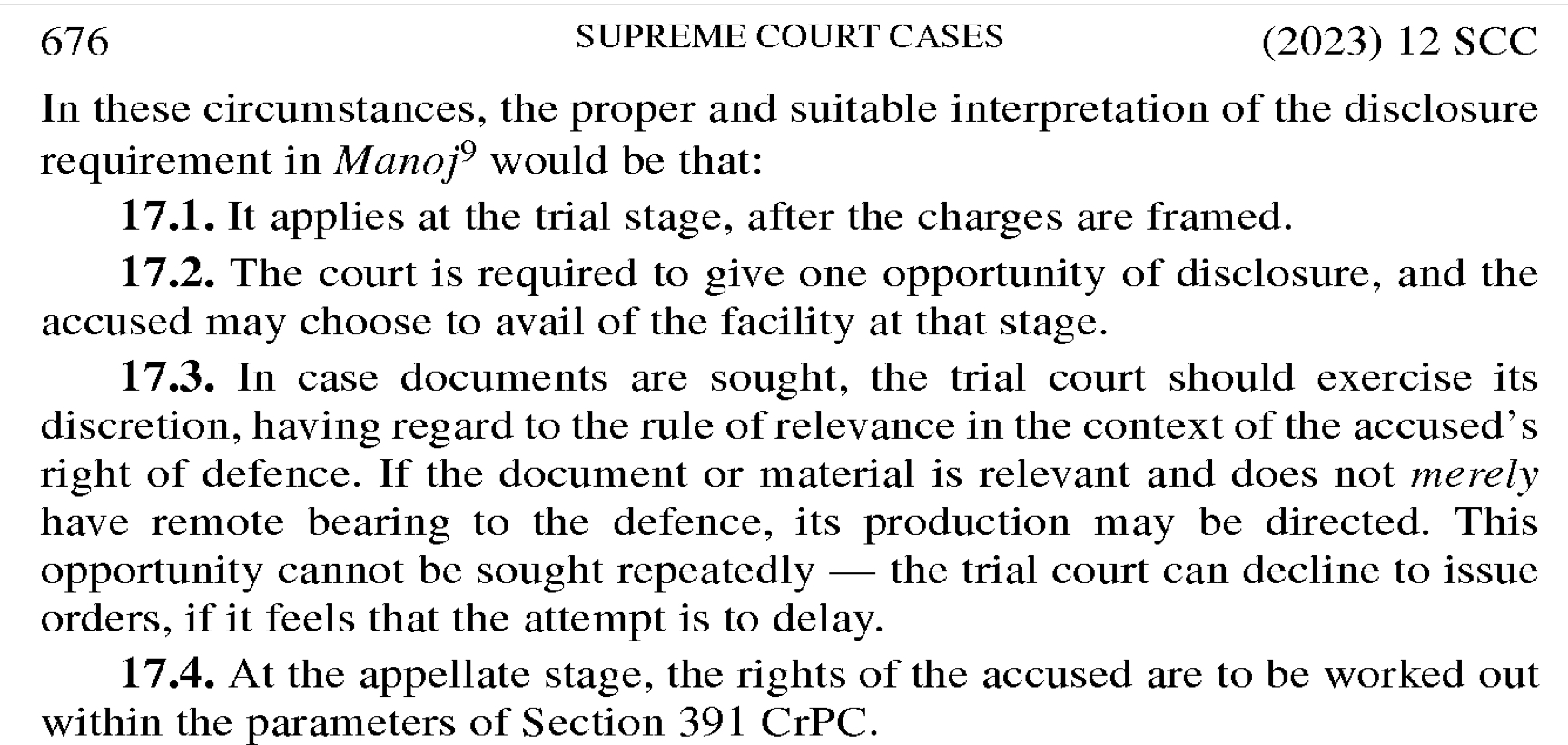
- These observations were, in our humble opinion, not needed. There was no occasion for the Court to opine on what stage does the right kick-in, as this was an appeal against conviction.
- The case did not concern itself with the stage of disclosure.
- Further, even ex facie, Paras 14 and 17.1 are vaguely worded.
- They do not distinguish between the the supply of the list and the supply of the documents themselves.
- Draft Rule 4 already tells us that the list is to be the given at the stage of Section 207 CrPC.
- Clause 17.3 is also vaguely worded. It doesn’t talk about the stage of disclosure.
I believe not noting the progressive Nitya and taking that jurisprudence forward was a big miss and observations regarding documents being available only at trial was a regressive step and placed too much power in the hands of the State, which is precisely what a good criminal procedure law should aim to counter.
The application of the above came up in Dheeraj Wadhawan’s decision:
Dheeraj Wadhawan (2023) DHC :
- Basic features of this case:
- Notes 2021 In re judgment. Also notes the Nitya decision.
- Does not say Nitya principle is bad or legally wrong. Doesn’t endorse it either.
- Para 25 holds:
- “a. That at the stage of Section 207 & 208 Cr. P.C., the list of other 207 & 208 Cr. P.C., the list of material (such as statements, or or objects/documents seized, but not relied on) should be furnished to the accused.
- b. The accused has the liberty to call for such unrelied documents at the stage of trial in accordance with the relevant provisions of Cr. P.C. i.e. Section 91 Cr. P.C.“
- It would be unfair to criticise this decision as, after Ponnusamy, there was little the Court could have done to make documents available at that stage.
There are various High Court decisions after this, but, broadly, in the same vein as above.
The next important landmark comes in the form of Sarla Gupta (2025) decision. Importantly, a 3 judge bench decision.
Sarla Gupta (2025 SC – 3 judges bench)
- What the Court held is :
- Accused, in a PMLA case, is entitled to the list of documents seized by the ED even at the stage of arguments on charge.
- This is fairly non-controversial and to be even suggesting otherwise, would be unconstitutional, apart from illegal and unfair.
- Accused, in a PMLA case, is also entitled to ‘Relied upon documents’. Of course!
- As regards Unrelied upon documents, which is really what the controversy is about, the court said the following:
- Para 38 – A list of unrelied documents is all that the accused is entitled to, at the stage of charge/discharge. Not the documents themselves.
- Following the lost, the accused can, at “Appropriate stage”, apply u/s 91 CrPC to get these documents:
- Para 40 onwards tries to answer, what is that stage?
- Para 44 : “Thus, this Court observed that the entitlement of the accused to seek an order under Section 91 CrPC for the production of the documents that are not relied upon would ordinarily not come till the stage of defence.”
- Para 49 notes Nitya but doesn’t weigh-in on what the relevance of the Nitya principle now would be.
- It can be argued that Nitya is not departed from or doubted at all and continues to be the law, especially read with ‘ordinarily’ in Para 44.
- Para 52 concludes:
- “Thus, we conclude that at the time of hearing for framing of charge, reliance can be placed only on the documents forming part of the chargesheet. In case of the PMLA, at the time of framing charge, reliance can be placed only on those documents which are produced along with the complaint or supplementary complaint. Though the accused will be entitled to the list of documents, objects, exhibits, etc. that are not relied upon by the ED at the stage of framing of charge, in ordinary course, the accused is not entitled to seek copies of the said documents at the stage of framing of charge”
- So, effectively, the court seems to be, once again, suggesting that let alone documents that the accused has in his/her own possession, even exculpatory material already in possession of the investigating body, cannot usually be summoned at that stage and the charge hearing has to confine itself with prosecution material.
- The usage of the “in ordinary course”, according to some, still leaves a window of opportunity open for accused to bring in something.
- But in what cases?
- What kind of documents?
- The case – disappointingly- doesn’t answer.
- This is the same ambiguity that the other cases left and does not guide any particularly helpful guidance for the Trial Courts who have to contend with these questions day in and day out.
- For those interested, Paras 58 to 60 are some paras on how such material would be procured and used during trial.
- Para 65, in a rather unprecedented twist, says that such unrelied upon documents, while not ordinarily available at charge, may be sought at the time of bail (given the higher threshold of bail that the accused has to satisfy in PMLA cases).
- While this is helpful by itself (to protect liberty), but saying that an accused may be entitled to something at the stage of bail, but not at hearing on charge, is slightly ironic.
- While it may help an accused who is in custody it would relatively disadvantage an accused who is not in custody at the stage of charge, which, frankly, sounds hardly logical.
As the reader can understand, all of this is, frankly, little progress and, in the ultimate analysis, a few steps backward from Nitya and CBI v. INX Media.
All you get, after 20 + years of judicial decisions, to cut this long story short, is a list of un-relied upon documents at the stage of charge.
It doesn’t guarantee that the correctness of the list.
That list, that the accused fights for to get, may be right or wrong. Factually correct or incorrect. There’s no way of knowing except in an inspection, which – again – may be an exercise while selective material is provided to the Accused. There’s simply no checks and balance.
Some Court have read Sarla Gupta to mean that there’s no inspection right anymore, but that, with great respect, is not the correct view.
This was not the question before Sarla Gupta.
But the main problem with Sarla Gupta lies in not contending with the whole issue of disclosure, with a clean slate, and taking a literal and narrow view of the matter, and in doing so it does a great disservice to the rights of the accused and the cause of equality at the stage of charge.
There should be complete disclosure at the stage of charge – of all that the investigators have collected or even ought to have collected. That is the only way an informed decision can be reached. That’s the only way to make charge hearings real and meaningful hearings.
The word ‘ordinarily’ and ‘in ordinary course’ in Sarla Gupta read with Nitya, is the hope on which we’d build future jurisprudence.
Conclusion: Toward Full Pre-Charge Disclosure – The Way Forward
Conclusionary Reform Call: It is time to unequivocally bury the idea that the accused must fight blindfolded or hands tied behind his back, until the trial opens. The evolution of case law – culminating in Nitya (2018), the 2021 Guidelines, and Sarla Gupta (2025) – has laid down the path but we need to do much more.
I, humbly propose, going forward:
- Full Disclosure: Investigating agencies should as a matter of course supply a list of all materials (relied or not) at charge stage, and be prepared to supply inspection/copies of those documents too, at that stage itself.
- If the list appears incomplete or selective, there should be ways of countering that as well by independent inspection or otherwise.
- Suppression of evidence should be deemed unacceptable.
- Courts should demand an explanation if any relevant evidence was not forwarded to court.
- The word “ordinarily” should not shield investigator/prosecutorial caprice; rather, it should allow judicial intervention to uphold fairness.
- Judicial Scrutiny at Charge: Trial judges should feel emboldened – by the likes of Nitya – to exercise discretion in favor of justice.
- If an accused cites a document from the case file that conclusively exonerates him, the judge should consider it in deciding discharge. The anxiety of avoiding mini-trials should not lead to narrowing a scope of this hearing but the decision should be left to the wisdom of the trial courts.
- This power must be used judiciously, yes, but also courageously when warranted.
- In close cases, doubt should tilt toward disclosure – because a trial can still proceed if the court is not fully convinced by the defence material, but an unfair discharge refusal cannot be remedied until years later on appeal.
- Legislative Action: It may even be worthwhile for Parliament to amend Section 173/207/227 (and its warrant-case counterpart Section 239, etc.) (I mean, they’re counterparts in BNSS) to explicitly permit courts to consider undeniable exculpatory evidence produced by the accused or present in the prosecution’s possession at the time of charge. Codifying the Satish Mehra/Rukmini/Nitya exception (for evidence of sterling quality) can give clearer guidance to lower courts, with clearer exposition on what can be seen at that stage.
- Training and Mindset Change: Police and prosecutors should be trained to view disclosure not as a charitable option but as an obligation tied to the right to fair trial. The Brady doctrine in the U.S. has by now ingrained that mindset: prosecutors there face reversals and even disciplinary action for withholding exculpatory evidence. Indian law could move in that direction – malafide suppression of evidence could be made grounds for departmental action or even contempt.
- When the incentives align towards disclosure, the culture will shift.
In sum, the trajectory of Indian case law – from Satish Mehra through Padhi to Sarla Gupta – shows a system meandering to find its equilibrium between efficient prosecution and the rights of the defence. It has, unfortunately, tilted to the former way more than the latter. The highest court has indeed spoken: Courts must insist on full and fair disclosure at the pre-charge stage; the accused cannot be made to fight with hands tied. But we need to make this hallowed principle a reality on the ground; we need to extend this practically and make this right useful by allowing it at the first instance possible.
Justice is best served when both sides lay their cards on the table.
It is often said that “Sunlight is the best disinfectant.” In criminal trials, sunlight in the form of disclosure at the earliest stage will disinfect the process of any latent unfairness. By embracing this fully, India will fulfill the promise of Article 21 and join the league of jurisdictions upholding the highest standards of justice, and ensuring that an innocent person does not face the rigmarole of a trial for decades, and is able to get a fair hearing at the stage of charge.
PS : I wish to thank my colleagues Jai Allagh, Maanish Chaudhary & Pushp for discussions on this topic and help with collating the judicial decisions together.


Leave a Reply