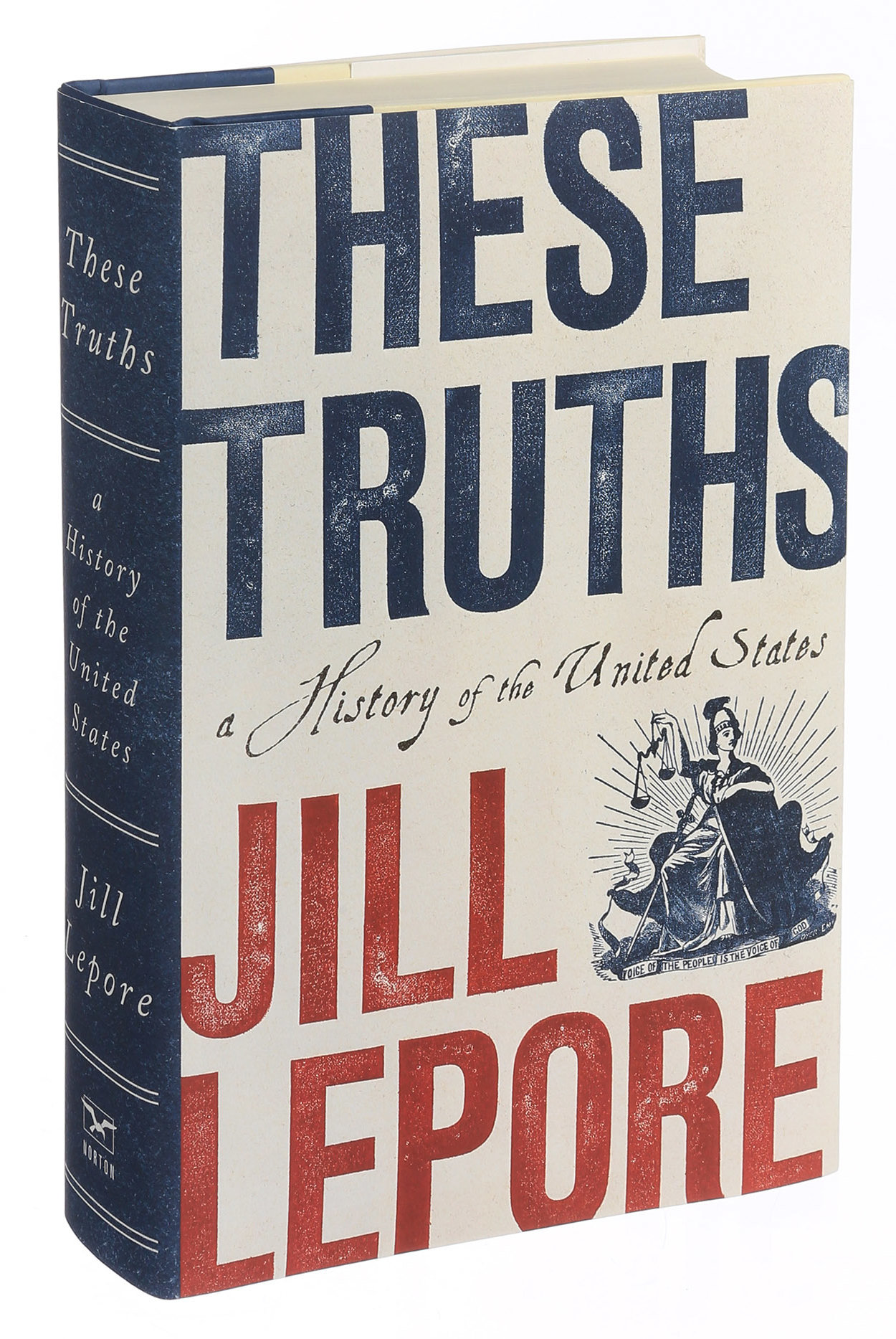
I absolutely love India and am fascinated by my country—and, to add a bit immodestly, have read a fair bit about it. But in order to understand it better, I wanted to see it in relation to another nation of great diversity—another democracy, arguably an older one. I wanted to read about the United States. This was, at least, the primary reason. The other reason was preparation for a visit later this year.
This is why I took up Jill Lepore’s These Truths. I am not disappointed. It packs more than 500 years of history—beginning with the first European settlements and the Native Americans, and culminating in the unsettling and surreal age of Trump. Lepore connects the dots between Jefferson’s and other Founding Fathers’ contradictions, the Gilded Age’s hypocrisies, and the digital age’s distortions of truth. And in doing so, she manages to be both sweeping in scope and intimate in tone—like a deep, personal whisper uttered at a noisy party, into the pining ears of a wallflower.
In this book, Lepore compresses centuries of political upheaval, social transformation, and moral struggle into a single, remarkably readable narrative. What sets it apart is not just its scope, but its soul. She doesn’t merely lay out what happened—she keeps returning to the question of why it happened, and what it meant for the ideas of truth, democracy, and equality, and for people around the world. She examines these themes through a range of perspectives and actors—but more often than not, and most importantly, through the lens of the underdog (which is something I love!).
Her writing is stunning. She is, at the same time, part historian, part philosopher, and part poet.
At no point did I feel bogged down by facts or data. Few books manage to make history come so alive, so continuous, so utterly—and painfully—relevant. Reading it, one realises that the American experiment, like India’s, is not a finished project but an ongoing argument with itself: noisy and contentious, yes, but still in a constant act of reinvention. That, perhaps, is reason enough to have faith in the power of ideas, law, and collective memory to hold a people together.


Leave a Reply