
Guest post by Kritika Malik (Research Head – Chambers of Bharat Chugh)
Every saint has a past and every sinner a future
Over time, both the Legislature and the Judiciary have tried to incorporate punishments promoting the reformation of convicts. There have been failed attempts on the part of lawmakers to add community service such as the Indian Penal Code (Amendment) Bill 1978. The recommendations of the Malimath Committee and the 156th Law Commission Report to include community service did not come into effect as well.
In Babu Singh v/s State of Uttar Pradesh the Apex Court emphasized on the importance of reformative measures within the justice system. In the words of Hon’ble Mr. Justice VR Krishna Iyer,
Restorative devises to redeem the man, even through community service, meditative drill, study classes or other resources should be innovated and playing foul with public peace by tampering with evidence, intimidating witnesses, or committing offences while on judicially sanctioned “free enterprise” should be provided against. No seeker of justice shall play confidence tricks on the Court or community. Conditions may be hung around bail orders, not to cripple but to protect. Such is the holistic jurisdiction and humanistic orientation invoked by the judicial discretion correlated to the values of our Constitution.
The High Courts have also drawn from this and have been imposing conditions like tree plantation, teaching the underprivileged and maintaining toilets etc. while quashing FIRs or granting bail- which in itself is problematic as being a punitive condition at the time of bail.
However, such a power was absent from the arsenal of judicial magistrates, who are traditionally seen as the backbone of the legal system, until recently. Some might contend that judicial magistrates could impose such conditions while granting probation for good conduct but an explicit provision for community service as a punishment was absent from the Criminal Laws of the country.
This position underwent a significant shift with the introduction of the Bharatiya Nyaya Sanhita 2023. This legal framework marks a new era by incorporating community service as a punitive measure. It prescribes community service as a punishment for petty offences like Public Servant unlawfully engaging in trade, non-appearance in response to a proclamation under section 84 BNSS, attempt to commit suicide to compel or restraint exercise of lawful power, misconduct in public by a drunken person, defamation and theft of property less than Rs. 5000 in case of a first-time offender who restores such value or property.
This is undoubtedly a turning point for India from a deterrent approach to punishment to a reformative one. With this addition, India has joined the ranks of many countries like Sweden, Netherlands, Norway, the UK, Canada and the USA. This hits two birds with one stone – First, the convicts are reformed and given a sense of purpose. Second, it reduces the burden on the filled-to-the-brim prisons and taxpayers’ money. It is most certainly a beneficial provision, but the legislature could have gone a step further with it.
Having said that a few things remain to be considered.
Things to ponder:
1) No specific definition of community service is provided, the explanation to Section 23 BNSS reads as follows:

There is no definition of what exactly community service is. Is it planting trees? Or is it teaching? Or can it be cleaning toilets and trash?
A missed opportunity was that community service could have been defined and clearly illustrated.
2)Community service has been prescribed as a punishment in only 6 offences. In order to fully utilise the benefits, there could have been more offences where community service could be prescribed. The level of overcrowding in our prisons warrant for alternative forms of punishment.
3)The provision for imprisonment in default of community service is vaguely termed.
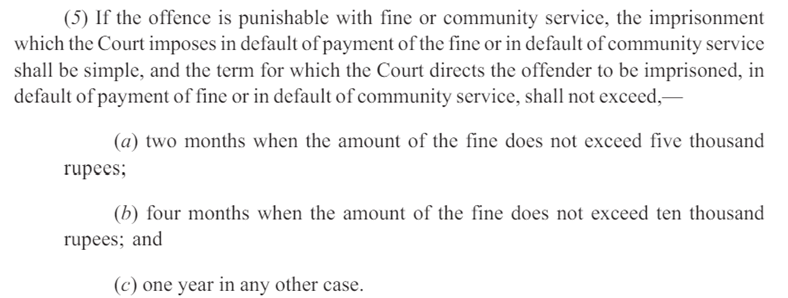
What seems is that for any default of community service the imprisonment granted shall be of one year. There may be a case where the offender is unable to perform the community service or has performed a percentage of it but still will face imprisonment for one year. A pro rata allotment may have been clearer and just.
4)The intent seems to be to grant community service in cases of petty offences. However, the addition of non-appearance in response to proclamation under Section 84 which is punishable with 3 years imprisonment and is a cognizable and non-bailable offence seems like an odd addition. Is contempt of lawful authority of public servants a petty offence? Would it have been better to leave out this offence?
Guest post by Kritika Malik (Research Head – Chambers of Bharat Chugh)
 The Blog of Bharat Chugh
Leave a Reply