Well, transitions are never easy.
CrPC, with all our bragging rights on knowing the sections, sub-sections, rules and exceptions, is now gone.
So is IPC.
BNSS and BNS now apply w.e.f 1st of July, 2024.
Now, on the application of the new laws, there is – indeed – no doubt that w.r.t offences committed after 1st of July, 2024 – BNS applies (as the substantive law) and BNSS applies to govern the procedure of investigation, inquiry and trial and all other proceedings.
So far so good. But this is only for new offences AND new investigations & Trials.
Problems, however, arise in the following situations:
- Where, for instance, the offence took place before 1.7.2024, but the FIR came to be registered after 1.7.2024 (in other words, the investigation, inquiry or trial are ALL after 1.7.2024);
- Where the offence took place before 1.7.2024, and FIR was also registered prior to 1.7.2024, but the inquiry (application of judicial mind on the results of the investigation post the filing of the police report), and trial (recording of evidence & the stage where charges are proved/disproved) commence after 1.7.2024;
These hypotheticals raise questions.
Normally, such transitional issues are sought to be solved by a legal expedient called the ‘Savings clause’.
Savings Clauses primarily:
- First, let the sleeping dogs lie, that is, they say : what’s happened has happened in the earlier law & the same is not upset just because the law is different now; also, if you’ve done something bad and liability has arisen (not necessarily adjudicated) you would face consequences;
- Second, they make a break from the past & provide for new provisions to govern situations and cases that arise from a certain point onwards;
But, as experience has shown, it’s hardly this uncomplicated.
Savings and repeals clauses are notoriously complicated and lead to a lot of (avoidable) litigation.
W.r.t the above problems, for instance, the same may indeed be covered by the savings & repeal, application, and sunset clauses in the new laws.
S.4(1) and 531 of BNSS (and 358 BNS) are the ones to be examined here.
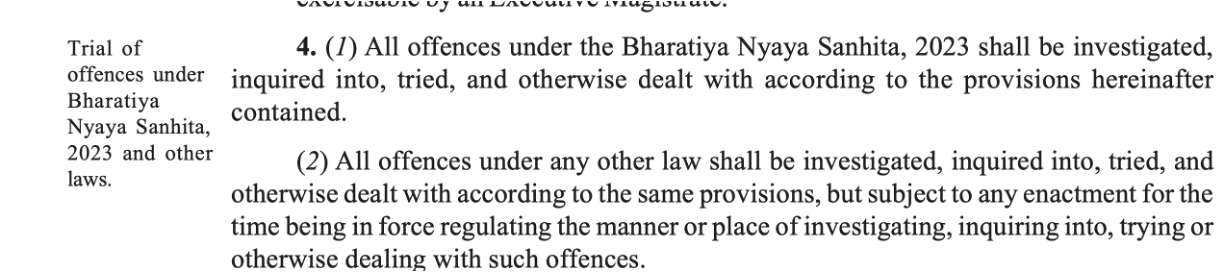
Simply put, Section 4(1) says : BNSS applies and governs procedure w.r.t BNS offences. Note : BNS offences. Not IPC Offences. This leads to a view that BNSS can govern procedure only w.r.t BNS offences and not IPC offences. (We argue separately that it would be difficult to read 4(2) to include IPC in the next post)
The question that now arises is what law – then – applies w.r.t IPC offences.
That is to say – offences committed prior to 1.7.2024 but w.r.t which proceedings have not been initiated prior to 1.7.2024.
Of course, they have to be punished. No two views about that.
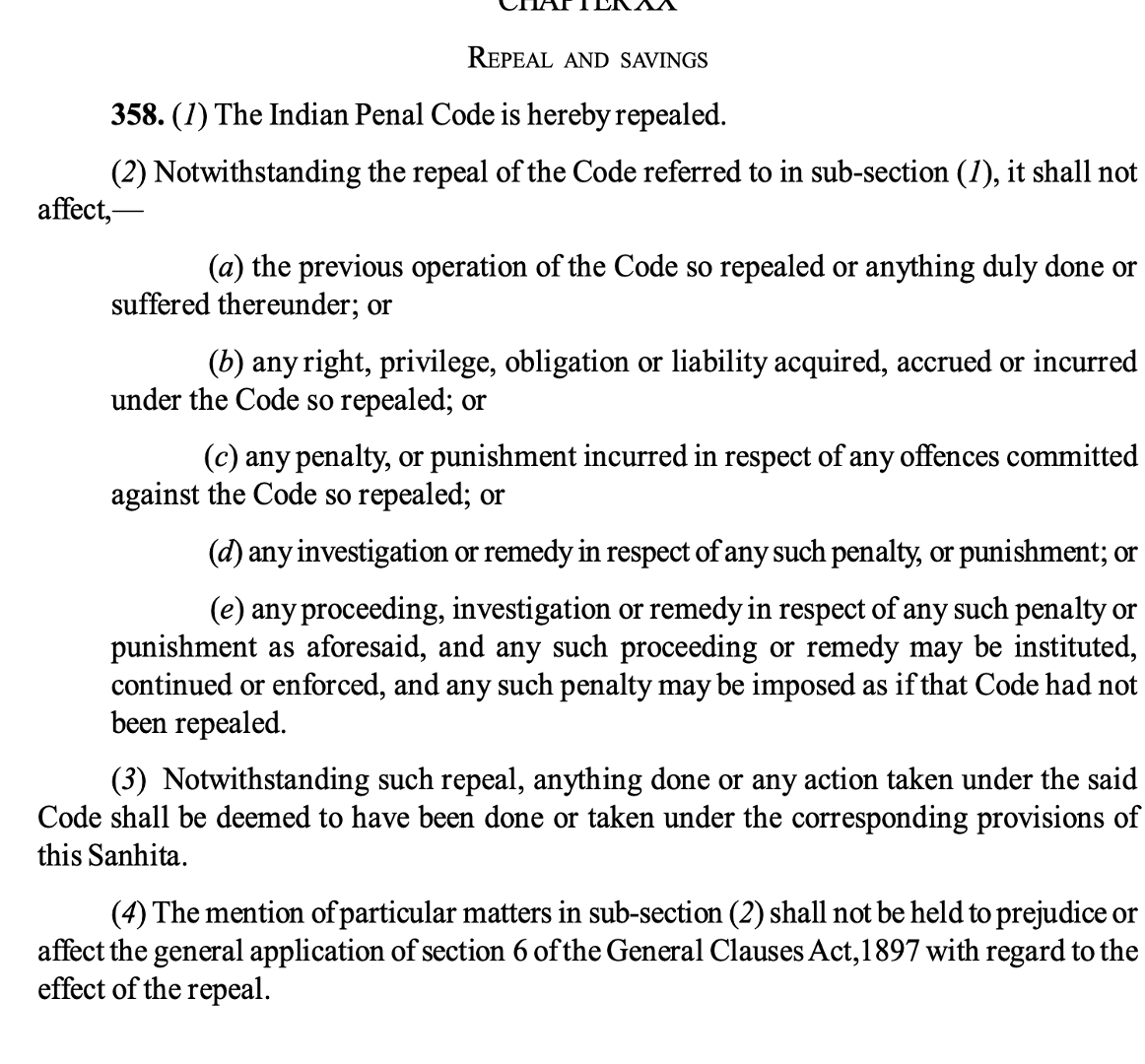
The sunset clause in IPC (S.358 BNS) makes it clear that there is no immunity from punishment/liability just because IPC stands repealed. You have to pay for what you did.
But where? and How? In CrPC or BNSS? CrPC also stands repealed, remember?
One view is : that since BNSS – by virtue of S.4(1)- only applies w.r.t BNS offences, it can’t be pressed-into action to investigate, inquire or try an IPC offence.
But what this view raises questions:
- Ok, fine, I understand but CrPC ceases to exist. So how does an investigator or a judge – today – apply a repealed law? A law that does not stand on the statute books.
- Section 358 BNS has been argued to mean : IPC offences prior to 1.7.2024 are not affected by repeal & any proceeding, investigation or remedy in respect of any such penalty or punishment may be instituted, continued or enforced, and any such penalty may be imposed as if that Code (IPC) had not been repealed.
- Note “as if that Code (IPC) had not been repealed”. Can this, by itself, revive CrPC for the purposes of application to such cases?
- While this section ensures punishment under IPC, it may not revive CrPC for procedural aspects post-repeal.
- At the cost of repetition, CrPC stands repealed today.
- Also, a reading of Section 531 BNSS seems to suggest that CrPC continues to apply only for the limited purpose of investigations, inquiries or trials already pending as on 1.7.2024.
- If – as is the case with our hypotheticals – the investigation, inquiry or trial is not pending as on 1.7.2024, and initiated only after the CrPC stands replaced and when BNSS holds the field, wouldn’t or shouldn’t BNSS take over and apply?
- Also, the mention of various kinds of proceedings such as investigation, inquiry, trials, applications indicates that even if a particular stage stands initiated prior to 1.7.2024, any subsequent stage would be governed by the new law. Otherwise, there’d be reason to mention all of these separately.
- Especially in the back-drop of the fact that there is a catena of judgments saying : procedural law applies to existing cases too/retrospectively and there’s no vested right to procedure. Especially, when the same is beneficial to the accused. Given that procedural laws normally apply retrospectively and the absence of CrPC in the statute books, BNSS should logically govern new investigations and trials even for IPC offences.
- But is it that simple?
Let’s see what the Courts have said on this, so far.
But, first, how the provision reads:
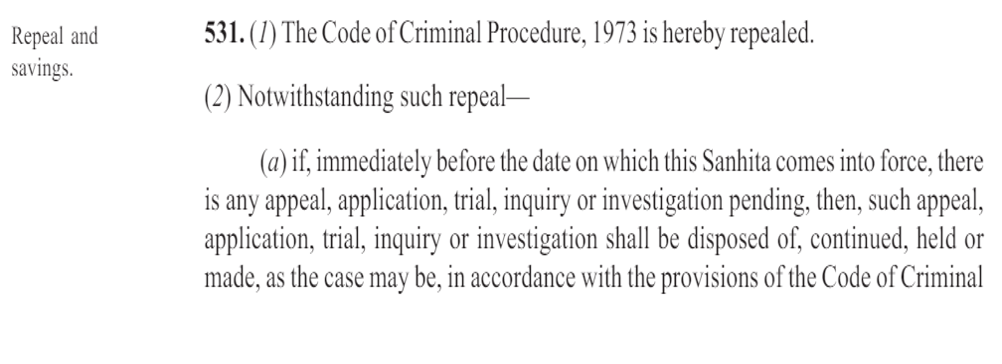
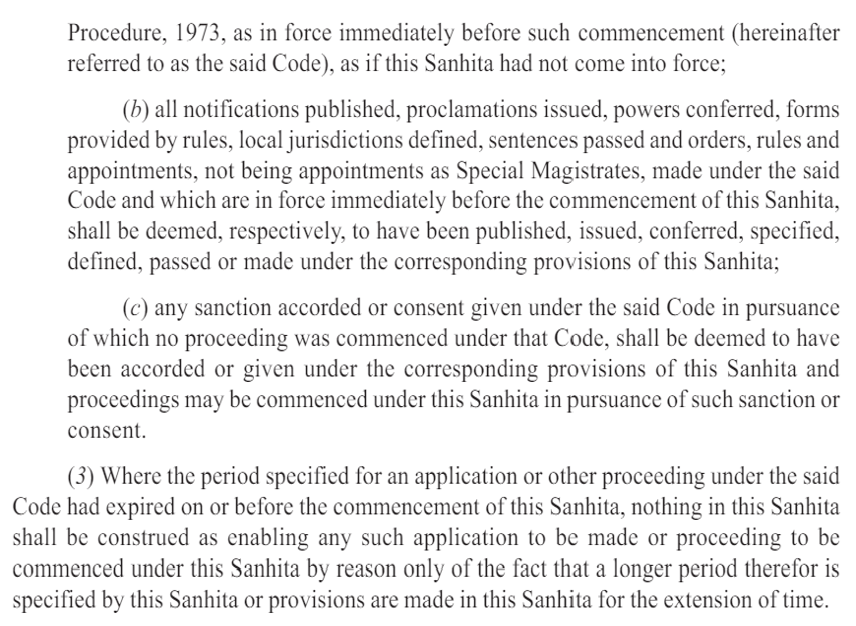
And the BNS savings clause too:
and S. 4 of BNSS:
On S. 531 a few thoughts:
- Section 531 BNSS is almost identical to Section 484 CrPC (which ensured a transition from the 1898 Code to the 1973 Code)
- The Courts interpreting Section 484 CrPC have held-
- Natabar Parida Bisnu Charan Parida vs State of Orissa 1975 SC
- Where the investigation was pending under the Old Code, it must continue under the Old Code.
- State of Maharashtra Vs Jawaharlal Shamlal Ujawane 1978 Bombay High Court
- Section 484(2) brings to the forefront that the old Criminal Procedure Code shall apply to appeals, applications, trials, inquiries or investigations pending immediately before the date on which the new Code came into force and that it does not save the old Code for the purpose of appeals, revisions, etc., to be filed after the commencement of the new Code arising against any proceedings which had been filed in the trial Court before the coming into force of the new Code.
Conflicting opinions on the interpretation of S. 531
There are two differing opinions coming up in latest judgements:
1)In case an FIR is registered prior to 01.07.24 then all subsequent proceedings shall be governed by CrPC.
2)Once the investigation/inquiry/trial/proceedings or appeal is pending then only such investigation /inquiry/trial/proceedings or appeal shall be governed by CrPC and any new investigation /inquiry/trial/proceedings or appeal shall be governed by BNSS.
The First View : That if anything is pending prior to 1.7.2024 all subsequent proceedings/stages are also governed by CrPC and not BNSS
Rajasthan High Court (Krishna Joshi v State of Rajasthan & Ors dt. 9.07.24-S.B. Criminal Misc(Pet.) No. 4285/2024)
- Criminal machinery is set into motion upon registration of an FIR.
- If FIR is registered prior to 01.07.2024 under CrPC, it would amount to pending investigation within the meaning of Section 531(2)(a) of BNSS. The entire subsequent investigation procedure and even trial shall be governed by CrPC.
- The twin action not only repeals the old law but enacts the new law. A certain transitional period is provided and a savings clause ensures a smooth transition. It means that all ongoing proceedings, which have already been kicked in under the old code, will not be disrupted by the BNSS.
- Rights of the accused in an FIR and/or under trials and/or convicts under appeal etc are protected.
2nd view : Whatever stage is pending on 1.7.2024 would only be governed by CrPC and rest by BNSS
Delhi High Court
- The Petitioner seeking anticipatory bail filed u/s 438 r/w S 482 CrPC
- The court opined on a plain reading of S 531(2)(a) that the present petition ought to have been filed under BNSS as it was filed after 01.07.24.
- Proceedings are to be “.disposed of, continued, held or made..” in accordance with the Cr.P.C. only in cases where such proceedings , viz.“… …any appeal, application, trial, inquiry or investigation..”, was pending immediately before the date on which the BNSS came into force. (Prince vs State of NCT of Delhi 12.07.24) [2024 LiveLaw(Del) 800]
- The wording of section 531(2)(a) of the BNSS is amenable to a possible interpretation that if an appeal is pending before the coming into force of the BNSS, only then would such appeal be continued under the Cr.P.C. (S Rabban Alam v CBI 10.07.24) CRL.A. 578/2024
Punjab and Haryana High Court
The court summarised the following-
- The Code of Criminal Procedure, 1973 stands repealed w.e.f. 01.07.2024. Ergo; no new/fresh appeal or application or revision or petition can be filed under Code of Criminal Procedure, 1973 on or after 01.07.2024.
- The provisions of Section 4 and Section 531 of BNSS, 2023 are mandatory in nature as a result whereof any appeal/application/revision/petition/trial/inquiry or investigation pending before 01.07.2024 are required to be disposed of, continued, held or made (as the case may be) in accordance with the provisions of Code of Criminal Procedure, 1973. In other words; any appeal/application/revision/petition filed on or after 01.07.2024, is required to be filed/instituted under the provisions of BNSS, 2023.
Another decision by Punjab and Haryana High Court
The court summarised the following-
- Any appeal/application/revision/petition filed on or after 01.07.2024 under the provisions of Cr.P.C., 1973 is non-maintainable & hence would deserve dismissal/rejection on this score alone. However, any appeal/application/revision/petition filed upto 30.06.2024 under the provisions of Cr.P.C., 1973 is maintainable in law. To clarify; in case any appeal/application/revision/petition is filed upto 30.06.2024 but there is defect and such defect is cured/removed on or after 01.07.2024, such appeal/application/revision/petition shall be deemed to have been validly filed/instituted on or after 01.07.2024 and, therefore, would be non- maintainable.
- Section 531 of BNSS shall apply to “revision”, “petition” petition of complaint”
XXX vs XXX 11.07.24 (LiveLaw (PH) 252 )
Another, Punjab and Haryana High Court
- Section 531 of the Bharatiya Nagarik Suraksha Sanhita, 2023 explicitly specifies that pending appeals shall be disposed of or continued as if the new law had not yet taken effect, following the provisions of CrPC. The petition and the accompanying application seeking an extension of time were filed and registered in the registry of this Court when CrPC, 1973 was in force and were pending on the 1st of July 2024; hence, they would fall under the scope of section 531(2)(a) of the BharatiyaNagarik Suraksha Sanhita, 2023. Therefore, based on the above, this petition shall have to be adjudicated under S. 401 of the CrPC, 1973 and not under S. 442 of the Bharatiya Nagarik Suraksha Sanhita, 2023.
Mandeep Singh V Kulwinder Singh- 2.07.24 CRR No. 2914 of 2023 (O&M)
Kerala High Court
- The Kerala High Court has laid down the following principles to determine whether the procedure under the Code of Criminal Procedure, 1973 (Cr. P.C) or Bharatiya Nagarik Suraksha Sanhita, 2023 (BNSS) is applicable when an appeal is filed.
- An appeal filed on or after 01.07.2024 shall be governed by BNSS
- Irrespective of whether the conviction was given on or before 01.07.2024 or if the appeal is filed on or after 01.07.2024, BNSS is to be followed
- All applications filed and steps taken in appeals prior to 01.07.2024 shall be governed by Cr. P.C
- When an appeal/ application is re-presented after curing defects, its date of filing shall be the date of its first presentation.
Abdul Khader v State of Kerala 15.07.24 CRL.A NO. 1186 OF 2024
Conclusion
There are varying views taken by various High Courts and, I believe, there’s a need for this to be settled by the Hon’ble Supreme Court.
 The Blog of Bharat Chugh
Leave a Reply