
Justice is rooted in confidence. A party cannot and must not choose its own judge. The same principle applies to arbitration. Yet, the practice of unilateral appointment of arbitrators—where one party selects the adjudicator—has been, pardon our French, a persistent legal nuisance, violating the very core principles of neutrality and fairness.
Fortunately, the jurisprudence on this issue is now fairly well-settled and the pernicious practice of unilateral appointment of arbitrators has been declared illegal by various courts, rendering any award passed under such circumstances non-est, unenforceable, and liable to be set aside..
This is clear from a number of judgments on the subject.
Let me quote a few – just to get the basics right on this. (and then we’d quickly jump to what can be termed an aberration of a decision which offsets some of this great progress).
The progressive march of the law. Coming down heavily on Unilateral Appointments.
It all started with TRF and Perkins, and then Bharat Broadband Network Limited (All by the Supreme Court) and then various benches of various High Courts.
The Delhi High Court also decided many of these and laid down some good law.
The legitimacy of arbitration rests on trust—once impartiality is sacrificed, the process collapses.
The Judgment in Man Industries v. Indian Oil Corporation (2023 SCC OnLine Del 3537), for instance, summarises the law in this regard well:
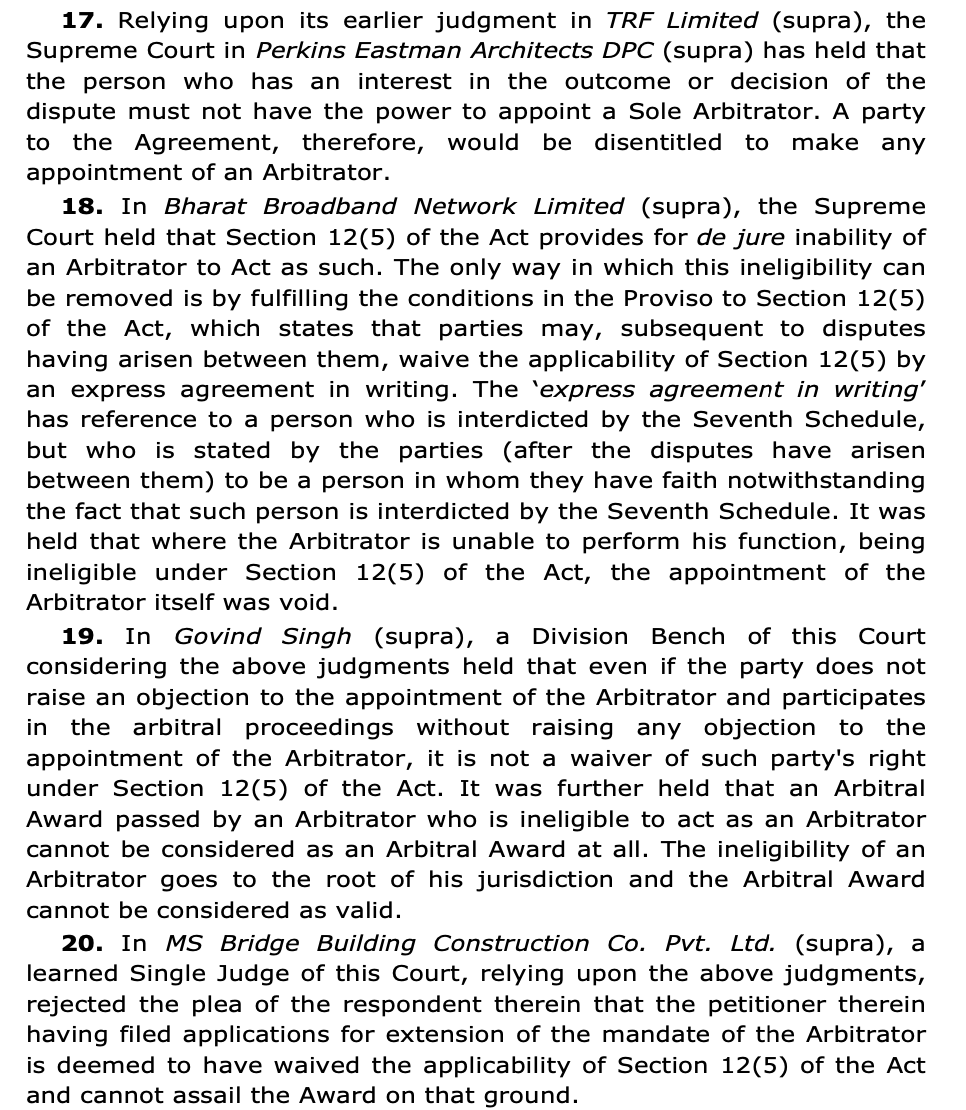
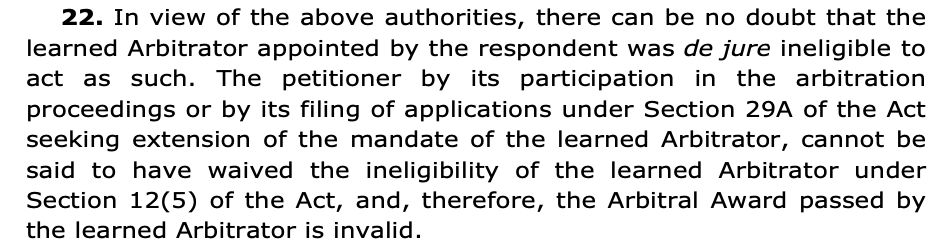
Man Industries actually went a step further and noted that such a plea can be taken up for the first time in a challenge u/s 34 of the Arbitration Act.
Later judgments extended this to execution or even collateral proceedings also, given the fact that this legal and jurisdictional issue goes to the very root of the matter and renders the arbitrator de-jure incapable.
Judgments also held that : participating in arbitral proceedings, filing of claims/counter-claims, non-challenge by way of a Section 16 Application or a Petition u/s 12 is ALL immaterial and does not disentitle a party from raising this claim.
In this regard, Man Industries said:

The Division Bench of the Delhi High Court in Govind Singh v. Satya Group & And (2023 SCC Online Del 37) further held:
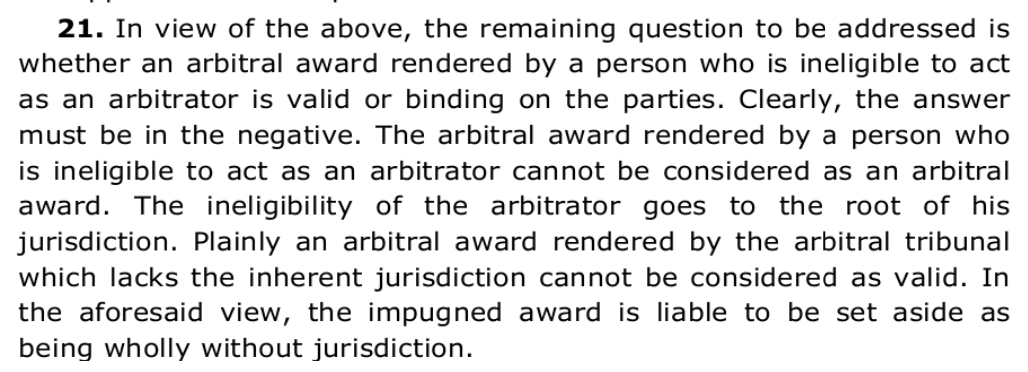
It also clarified that the fact that the parties participated in the proceedings would not make a difference and the only thing that would make a difference is : an express agreement in writing between the parties – specifically and explicitly waiving such an objection, and that too, after the dispute had arisen between the parties.
The Calcutta High Court in Cholamandalam Investment & Finance Company v. Amrapali Enterprises (2023 SCC Online Cal 605) remarked such awards as bearing a ‘permanent and indelible mark of bias and prejudice’ which cannot be washed away. It said:

It went on to say that such awards are absolute nullities and even executing courts ought to dismiss them as unenforceable.
It further said:
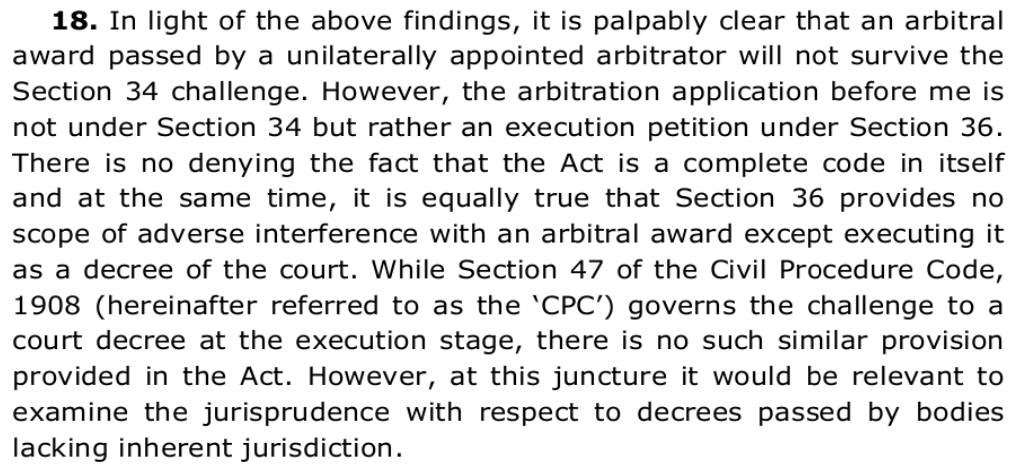

If Award by Unilaterally appointed Arbitrator – it is unenforceable
Closer to home, the Delhi High Court in Kotak Mahindra Bank v. Narendra Kumar Prajapat, 2023 SCC Online Del 3148 upheld a very erudite judgment of a Commercial Court(presided-over by Justice SS Rathi) dismissing an execution petition in such a case. It held:

(SLP against Kotak Mahindra was dismissed vide order dated 12.12.2023)
At the heart of arbitration lies neutrality—an even playing field where both sides are heard with impartiality. Unilateral appointment tramples this very essence.
A Single Judge of the Delhi High Court in Smaash Leisure Ltd v. Ambience Commercial Developers Pvt. Ltd (2023 SCC Online Del 8322) similarly held:

Fortunately, the Courts overcame their tendency to hold executing courts jurisdiction to be extremely limited. These awards were taken as absolute nullities and not worthy of the phrase ‘arbitral award’ and empowered executing courts to dismiss them – without earning the scorn on ‘going behind the decree’. There is no decree (or award) to begin with – the Courts reasoned.
A Controversial Note: Arjun Mall Retail Holdings v. Gunocen (2024)
While most courts gladly spoke in one voice on the illegality of unilateral appointments, the recent ruling in Arjun Mall Retail Holdings v. Gunocen struck a somewhat discordant and – one must add – a very disconcerting note.
In this case, despite acknowledging the factum of unilateral appointment, the court denied relief to the award debtor reasoning that the objection was not raised earlier in the arbitral proceedings. It held:
Para 35 : The aforesaid dictum in Airport Metro Express (Supra) makes it clear that under Section 34 of the Act, scope of interference by the courts is very limited and only if there is any patent illegality in the Arbitral Award, then only it is required to be touched upon. In the present case, even if it is accepted that the appellants had raised objection to the appointment of learned Arbitrator by sending a letter to him but the fact remains that the appointment was never challenged under the provisions of Section 11(6) of the Act, 1996 nor did the appellants participate in arbitral proceedings, despite having knowledge of the same. Instead of contesting the respondent’s claim before the learned Arbitrator, the appellants remained mute spectator and only after losing the battle in arbitral proceedings, the appellants preferred appeal under Section 34 of the Act, challenging the appointment of Arbitrator as well as the Arbitral Award.
This finding is clearly flawed for the following reasons:
- The judgment in Arjun Mall does not consider the impact of statutory provisions, TVF, Perkins and the entire line of decisions of Supreme Court.
- It is important to bear in mind that the Supreme Court, while dismissing the SLP in Arjun Mall (w.r.t decision above) consciously kept the legal issue open. (Though it would have been much better for the Supreme Court to decide it and hold Arjun Mall judgment to be incorrectly decided)
- The decision (in Arjun Mall) is also not good law in view of various division bench decisions of the Hon’ble Delhi High Court holding to the contrary. Judicial discipline demanded that, if the Court disagreed with those, it ought to have referred the matter to a larger bench for consideration. It could not have simply gone against the grain of established jurisprudence.
- Further, the Judgment is also – arguably – per incuriam having been issued in disregard of settled binding precedent. In fact, it does not even discuss much less analyse the applicable law.
Fortunately, these are the precise reasons on which Courts have disregarded Arjun Mall as a binding precedent.
Some of these are as follows:
Course Correction | Reviving Confidence
In Airport Authority of India v. TDI International Pvt. Ltd. (2024 SCC Online Del 4016), for instance, the Hon’ble Delhi High Court had the following to say:
Para 25 : Mr. Mohan, however, draws my attention to a judgment in Arjun Mall, wherein the Division Bench has taken the view that this ground cannot be raised for the first time in a petition under Section 34 of the Act, if it was not raised in arbitral proceedings. It may first be noticed that the prior judgments of the Division Bench of this Court in Govind Singh , Ram Kumar , Kotak Mahindra, and Babu Lal do not appear to have been brought to the attention of the Bench in Arjun Mall It may also be noticed that the Division Bench relied upon the decision of the Supreme Court in Delhi Airport Metro Express (P) Ltd. v. DMRC56 , which has specifically been set aside by the Supreme Court in Curative Petition Nos. 108-109/202257 .
The Court in AAI further went on to observe:
The question before this Court is, therefore, whether to follow the earlier judgments in Govind Singh , Ram Kumar , Kotak Mahindra and – Babu Lal, or the later view taken in Arjun Mall . This question is answered by reference to the judgment of the Supreme Court in Sundeep Kumar Bafna v. State of Maharashtra, which holds that, in the event of mutually irreconcilable decisions of the Supreme Court being cited before the High Court, “the inviolable recourse is to apply the earliest view.” No authority to the contrary has been cited before me, and I see no reason to depart from this principle when it comes to mutually irreconcilable decisions of the Division Bench, placed before a Single Judge.
To similar effect are the judgments in S.K.Builders v. CLS Construction Pvt. Ltd (2024 SCC Online Del 5498) and Sunil Sethi v. Hero FinCorp (2024 Scc Online Del 1476).
In SK Builders, the Court held:
It is also significant that even while dismissing the SLP preferred against the judgment of the Division Bench in Arjun Mall Retail Holdings, the Supreme Court left the question of law open. This clearly indicates that, even in the opinion of the Supreme Court, the question of whether an arbitration which proceeds following the unilateral appointment of the Arbitrator, can at all sustain, deserved consideration.
“An award tainted by unilateral appointment is a nullity—forever carrying the stain of bias.”
Parting words
The practice of unilateral appointment of arbitrators is not just an annoyance—it is a legal and moral aberration that strikes at the heart of the principles of fairness and equality. It blurs the line between arbitration and adjudication-by-bias. Courts and legislatures across the globe are waking up to this malpractice, rendering it increasingly untenable. As we move forward, the future of arbitration must prioritize neutrality over convenience, equality over control, and justice over mere formality. Anything less is an affront to the very idea of arbitration—where fairness, not favoritism, is meant to reign.
The recent decisions refusing to uphold and apply Arjun Mall judgment are a healthy testament to these principles and a much needed course correction.
Authored by Bharat Chugh (Founder) & Ajatshatru Singh Rawat (Counsel) at the Chambers of Bharat Chugh
 The Blog of Bharat Chugh
Leave a Reply