
Let’s start at the start:
DHC (Original Side) Rules, 2018 (In short “DHC Rules”) govern the adjudication and procedure of suits instituted/pending before DHC – on the original side (Cases that the HC’s civil side takes up as court of first instance given that the amount involved is over and above a particular threshold).
Rule 4 of Chapter VII is the rule in question here. (In short “The Rule”).
Rule is fairly simple. It provides for the time-limit in which a WS must be filed in a civil case.
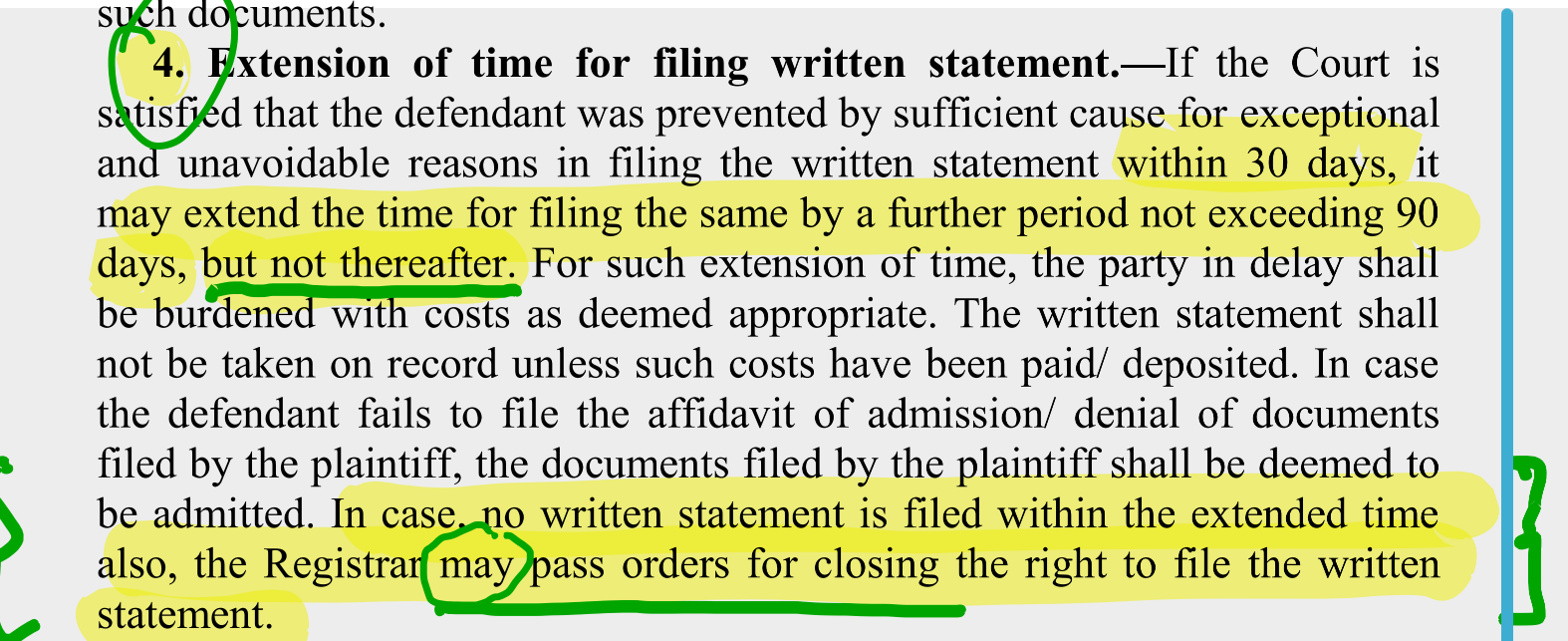
A bare perusal of this Rule reveals that this marks a departure from the relevant provisions in this regard in CPC i.e Order 8 Rule 1, Rule 5 and Rule 10 CPC.
The idea being : as far as possible, cases ought to be decided on merits and not on technical considerations. And Courts and procedural law both exist not to call people out for their technical fouls/faults/procedural lapses, but to do substantive justice. Procedure, as some very fine jurists have put it, is the handmaid of justice.
In this regard the Commercial Courts Act (“CCA”) may also be recapitulated. You’d recall it sought to change this position for suits pertaining to ‘commercial disputes’ under the CC Act. A specific class of disputes where (given the nature and stakes involved) the law (and, later, the Courts) felt the time-limit should be inflexible and no extension possible for filing of a WS.
Now, one view is that the DHC rules seek to incorporate and extend the same logic to all suits on the original side in the Delhi High Court. (Though the language in CC and DHC Rules – though similar – is not the same, one must note).
Now there are multiple reasons why they shouldn’t. It’s not hard to think of situations where a litigant may not be in a position to file a WS in that specific time period – at all. For instance, cases of prolonged serious illness. Or a difficulty such as COVID. In view of the myriad situations and difficulties that life throws up, it was thought wise and prudent to keep this time-limit flexible and, in appropriate cases, and for sufficient cause, allow filing of WS even beyond the stipulated period. This is especially given the fact that the consequences of not filing the WS are grave and serious. (The allegations in the plaint may all be taken to have been admitted if no WS is filed, in some cases).
Further, a rule like that also – arguably – discriminates between defendants defending suits before the original side of the High Court and those defending suits at the District Level. While the latter may be entitled to extensions, the former are deprived of that indulgence, sometimes with disastrous consequences.
Similarly, Defendants in civil suits in DHC cannot be worse-off than defendants in civil suits elsewhere in the country.
This hardly sounds equal, or fair.
Also, while the logic of keeping time-lines strict in CCA is understandable.
Extension of the same logic to all civil suits across the board, where the level of sophistication and means/capacities of litigants may not be same, may mete out great injustice. It may, as someone put it, amount to treating unequals as equals, which is anathema to equality.
It is clear that the DHC Rule in question (making time-limit rigid and inflexible) may mete-out great injustice and deprive deserving cases of even a basic trial. This would also impact qualitative adjudication of cases after proper appreciation of evidence.
But this column doesn’t wish to share thoughts on this alone. It seeks to underscore a larger problem.
This is the problem of judicial uncertainty & inconsistent verdicts on the same legal issues.
Now, let’s take a few steps back. We saw, earlier, that this rule was introduced in 2018. Before that, we all understand, the law was that : time-period for filing of WS is not cast in stone and can be condoned. (Please see the Salem case and Kailash v. Nankhu amongst others, for those who arrived late).
But 2018 Rules, it is argued, make a departure.
Now, first things first, it is arguable that the 2018 rule itself, properly and holistically read does not make a departure and reserves the power with the Court/Registrar to extend the period and condone delays even beyond 120 days. The same – one may argue – is implicit in the last part of The Rule which enables the Registrar to pass an order closing the right to file WS, upon expiry of that period. Please note – it is an enabling provision. It says “The Registrar may“. (More on this reasoning in a bit!). It doesn’t say the Registrar must close the right in all cases where WS is not filed within time.
The contrary interpretation is that the use of the phraseology “but not thereafter” indicates that the time-limit is mandatory and not capable of extension. [Further, it is argued (and – this part of the reasoning may be unexceptionable and is not being opposed) that Rules made by a HC in exercise of S.129 of CPC would supersede the CPC provisions in this regard.]
[The issue, according to the author, is not of these rules being ultra-vires the CPC, but being against, inter-alia, the right to equality, fair & due process, and principle against retroactivity and taking away substantive rights, etc. etc, but more on that later]
Now, and coming back, with these two ex-facie competing interpretations, let’s start with how the Courts looked at this position and the enormous legal uncertainty that followed.
One of the first decisions where the Court was called upon to rule in this regard was the case of Esha Gupta v. Rohit VIG (2020 SCC OnLine Del 2702) where after duly noticing The Rule, the court had the following to say:
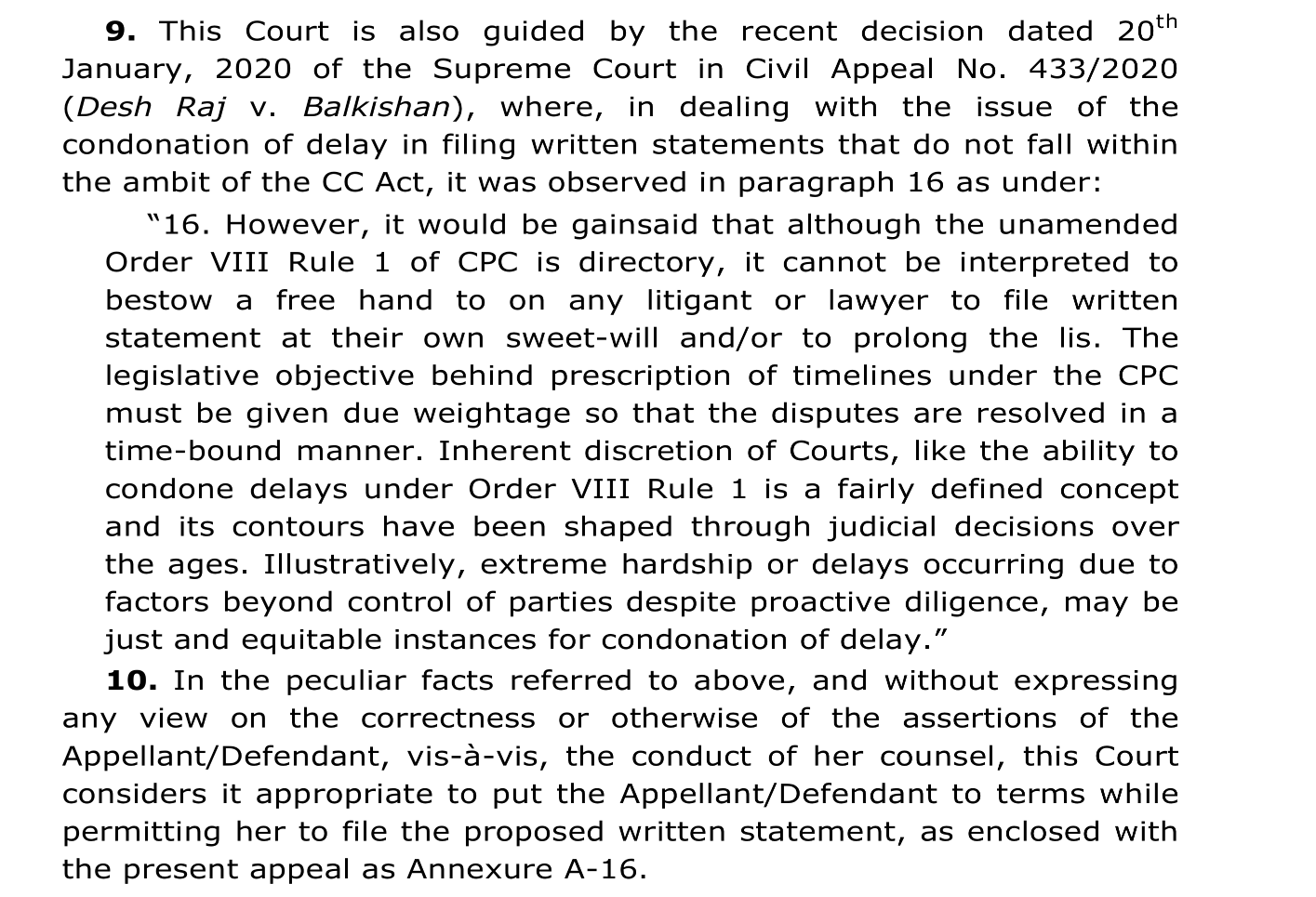
This was a Division Bench decision. (This fact would become relevant a little later when we examine whether subsequent benches could have taken a different view).
In August, 2020, a single Judge of the DHC in Gautam Gambhir and Ram Sarup Lugani, by a common judgment, took the view that the delay in filing of Replication cannot be condoned. The Court held:
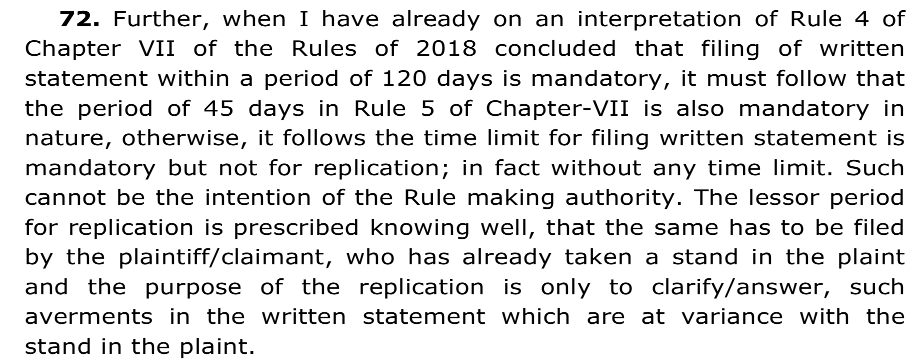
With great respect, in this decision, some conflation happened between the time-limit for filing of Replication and WS and both are equated and there are parallel’s drawn.
This, in the author’s humble opinion, would conflate and compare unequals and result in the law meandering where it shouldn’t have.
For completeness, the relevant rule in connection with Replication, is as follows:
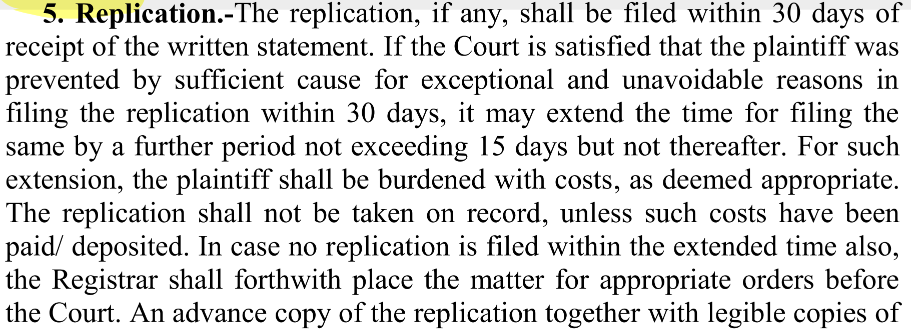

Now a bare perusal and juxtaposition of this provision with Rule 4 (which concerns WS) shows that they are differently worded.
Rule 5 does envisage Registrar’s enabling power as is the case with the provision on WS.
Further, the mere fact that the consequences of not filing a Replication and WS are vastly different, ought to have made the Court take a different view.
Not filing a Replication, more often than not, hardly makes a difference. We’ve been taught by Justice Lahoti’s erudite and elegant verdict in Anant Constructions v. Ram Niwas (1994 DHC) that a replication need not even be filed until and unless Plaintiff wants to admit some of the defendant’s contentions but place a different interpretation on it. (Read : The Theory of Assumed Traverse and Confession & Avoidance).
To put it simply, not filing a Replication does not amount to admitting the contents of the WS.
Whereas, not filing a WS may amount to admission of the contents of the Plaint. Given these vastly different consequences, the Court ought to have not equated the rule providing for time-limit for WS with the rule providing for the time limit for Replication.
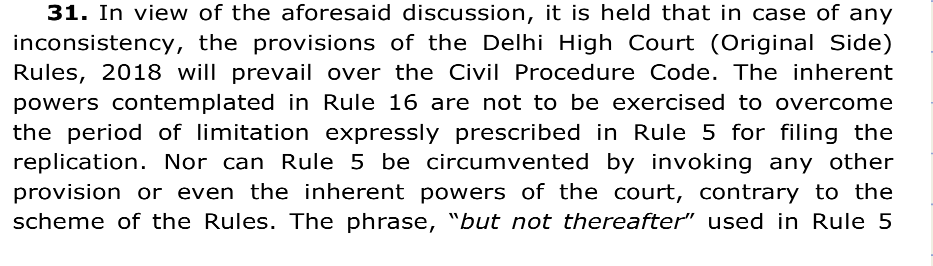
Be that as it may, the decision in Gautam Gambhir and Lugani was upheld by the Division Bench in 2020 SCC OnLine Del 1353 titled Ram Sarup Lugani v. Nirmal Lugani & Others, where the Court held:

But coming back to the line of decisions which deal with the filing of WS specifically.
In January, 2021, another Division Bench of the Delhi High Court in Tushar Bansal’s case had this to say:
“We have heard learned counsel for the parties and perused the record. Learned counsel for the respondent No.5 (plaintiff in the suit) fairly does not oppose the appellant’s prayer for condonation of delay in filing the written statement. In the light of this stand taken by the respondent and Rule-16 of the Delhi High Court (Original Side) Rules, 2018 which clothes the Court with inherent powers to make such orders as may be necessary for the ends of justice or to prevent abuse of the process of Court; we are of the view that it will be in the interest of justice to condone the delay in filing of written statement by the appellant.”
Yes, the no-objection of the opposite party played a part but the Court also referred to Rule 16 of the DHC Rules, 2018, to held the delay to be condonable and condoned the delay. (The author concedes that the decision may be assailable on the ground that Rule 16 was not meant to be exercised to condone delays in such situations and the context and import of the provision is wholly different).
Rule 16 reads :

The carousel kept turning.
Specifically in the context of time-limits for WS, a number of decisions came up.
Harjyot Singh was one such case. (2021 SCC Online Del 2629) where the Court held:
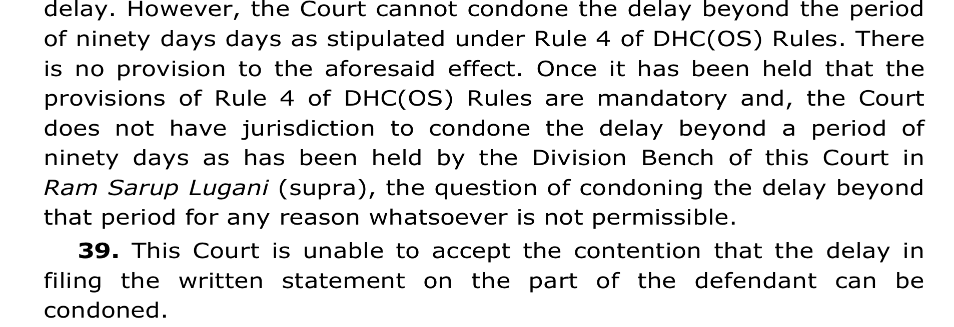
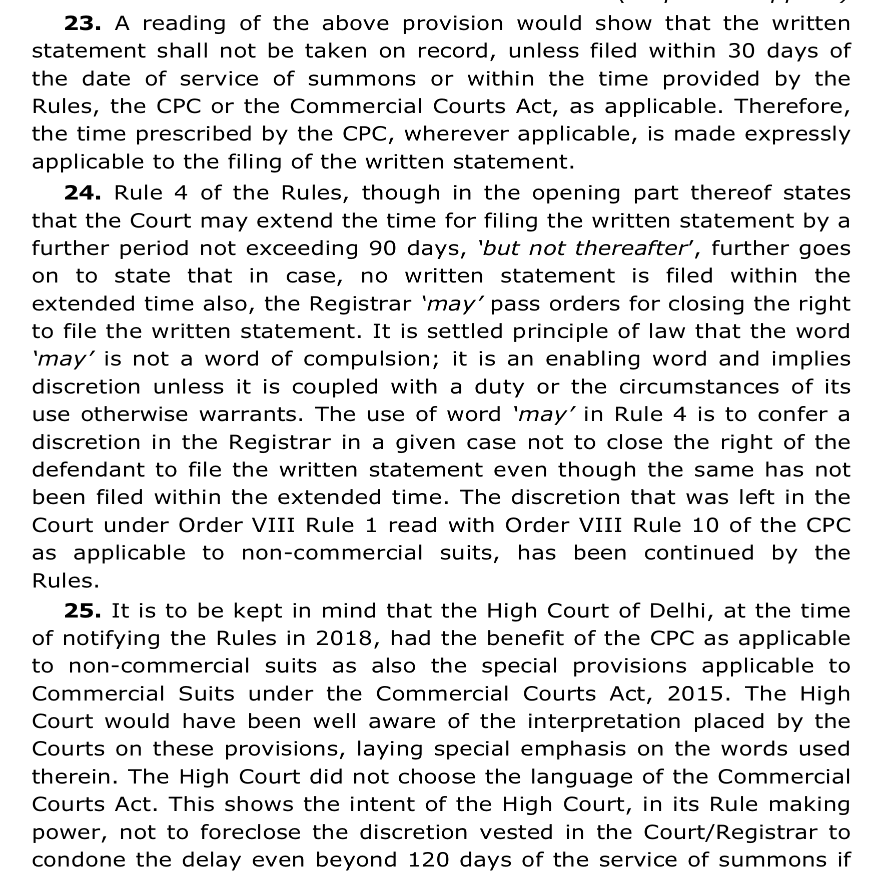
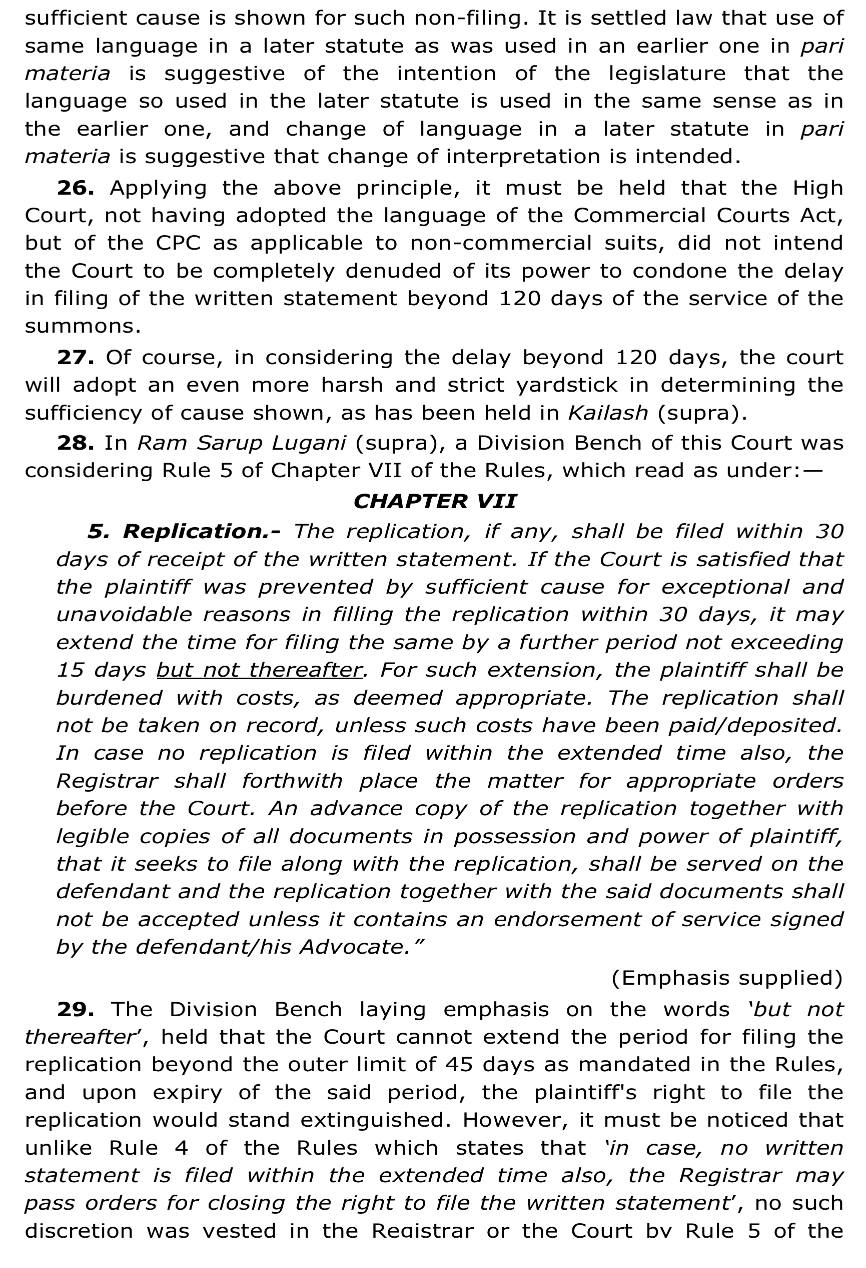
Later, however, the Court took a different view in : Amarendra Shari Singh v. R.C.Nursery Private Limited, 2023 SCC OnLine Del 84.
This case showed a a detailed and surgical discussion of the law in this regard and its reasoning is being reproduced here – in extenso – being extremely informative. While holding the delay to be condonable and the time limit not to be cast in stone, the Court held :
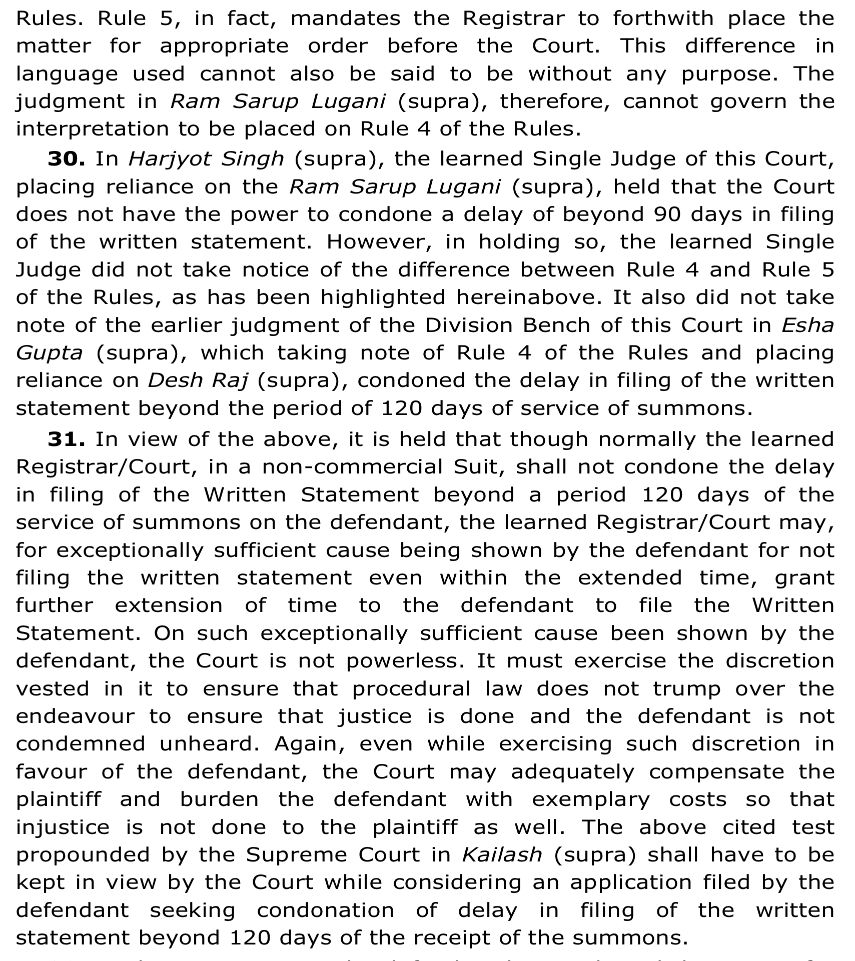
This was an important decision and, in the Author’s humble opinion, the correct view as :
- It takes note of the language of the provision, and juxtaposes this with the CPC provision.
- It also juxtaposes it with the CCA language and observes fine distinctions between the two;
- It exposes the fallacy in equating the provision relating to replication with the provision relating to WS;
- it traces the law from Esha Gupta (which appears to be the first decision dealing with The Rule and the objection) and builds from there.
- It also demonstrates as to how earlier decisions such as Harjyot Singh (Single Judge) do not notice the distinction between Rule 4 and Rule 5,, and the Division Bench decision in Esha Gupta.
- It vests the Court with the discretion to condone delays in appropriate cases and do justice to parties.
- And is, it goes without saying, broadly fairer and more humane as a rule, and more in line with established thinking on the subject.
But the carousel turns yet again. This time in Charu Agrawal v. Ashok Kalia and Ors, a Single Judge of the DHC – once again – takes a view that the delay is not condonable.
We deal with the above decision, Manhar Sabharwal, and other decisions in the next part and try and make a case for : 1) This provision to be read as directory, and not mandatory; and 2) At any rate, for this provision to be read as mandatory only prospectively and not operate to the prejudice of parties who, bona fide, acted on the assumption that the law at the time was that the provision is directory.
It would, in this exercise, draw sustenance from the established principles of : substantive/vested rights can’t (and shouldn’t) be taken away by retrospective laws and judgments, and the fact that : acts of courts shall prejudice no-one. And in doing so, make a larger case for procedural law to be looked-at in a certain way, and make some points in the favour of certainty of law being the strength and fairness of law.
The Author appreciates and acknowledges the efforts made by his team in putting the research on this together including but not limited to Abhinav Aggarwal, Vanya & Aditya Narayan.
 The Blog of Bharat Chugh
Leave a Reply