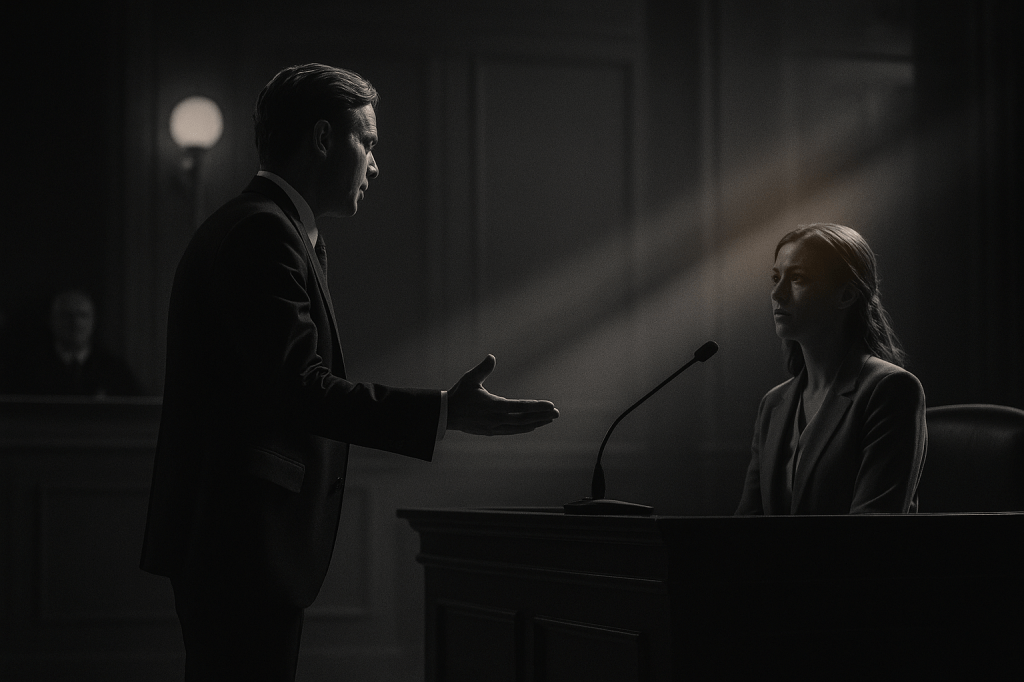
“Judge a man by his questions rather than his answers.” – Voltaire
Introduction
In trial advocacy, especially in common-law systems, a distinctive (and curious) feature of cross-examination is the use of “suggestions” or “putting one’s case” to a witness. These are not ordinary open-ended questions of fact, but – rather – statements a lawyer puts to the witness embodying the examiner’s version of events or narrative. This practice serves to challenge the witness’s testimony and present the opposing party’s case, ensuring the witness has a chance to respond. It differs markedly from the open-ended questioning in examination-in-chief.
There is, however, significant debate – in India and abroad – about the need and evidentiary value of such suggestions and whether a suggestion by counsel can be considered against the party represented by that counsel.
Just to start at the start, we, first, define these concepts, distinguish suggestions from normal Q&A, compare global and Indian positions, and examine key judicial decisions on both sides of the admission debate, including recent developments following Browne v. Dunn.
What Are “Suggestions” and Why Put One’s Case?
In cross-examination, suggestions (often phrased as “I put it to you that…”) are essentially statements that reflect the cross-examiner’s own case or theory, which the witness is invited to affirm or deny[1]. For example, a defense lawyer might say: “I suggest that you never actually saw the accused at the scene, because you were in a different city at that time,” to which the witness may respond, “It is wrong to suggest that – I was indeed present and saw him”. Unlike ordinary questions aimed at eliciting new facts (the who/what/where/when), suggestions typically contain the answer the examiner expects (or hopes) to hear[2][1]. Their primary purpose is not to gather unknown information, but to challengethe witness’s account and lay out the opposing version for the record[3]. In criminal trials (which lack formal pleadings), giving suggestions is considered important to unveil the accused’s defense narrative to the court[3] and to give the witness a fair opportunity to comment on it. By contrast, in a civil trial with detailed pleadings, some courts have opined that exhaustive suggestions are unnecessary because the party’s case is already explicit in the pleadings[4][5].
[Apologies on quoting myself from an earlier blog. For the record, I do not – for a moment – subscribe to Shaw when he says : “I love to quote myself, it adds spark to my conversation!)
On logic, putting one’s case to the witness is a rule of fairness: if a party will later argue that a witness is wrong or lying on a material point, the party is expected to confront the witness with that contradiction during cross-exam. In other words, the cross-examiner should “put” his version of events to the witness so that the witness has an opportunity to explain or rebut it[6][7]. This serves the fundamental principle of audi alteram partem (hear the other side) – it is unjust to withhold your contradictory theory until closing arguments without giving the witness a chance to respond[6]. As Lord Halsbury stated in the seminal case Browne v. Dunn (1893): “…nothing would be more absolutely unjust than not to cross-examine witnesses… and, not having given them such an opportunity, to ask the jury afterwards to disbelieve what they have said, although not one question has been directed [to it].”[6]. In practice, then, suggestions are the vehicle by which counsel “puts the case” to an opposing witness – typically resulting in the witness’s denial, but fulfilling the duty to challenge their evidence.
How Suggestions Differ from Ordinary Q&A
Leading nature: Unlike neutral open questions, suggestions in cross-exam are a form of leading question – they suggest the answer within the question itself[2]. An ordinary question in examination-in-chief might be, “Where were you standing at the time of the incident?”; a suggestion on cross-exam would be, “I put it to you that at the time of the incident, you were standing nowhere near the scene, but elsewhere entirely.” The latter plainly asserts the examiner’s version, to which the witness can only agree or disagree. Indeed, in cross-examination it is generally permissible (and common) to ask leading questions[2], whereas in direct examination leading questions are restricted.
Counsel’s narrative vs. witness’s narrative: When an attorney makes a suggestion, they are effectively testifying to their theory (though not as evidence) and demanding the witness’s comment[1]. This contrasts with normal Q&A where the witness provides their own account in response to open prompts. Suggestions thereby serve to pin down the witness on specific points of contention – e.g. suggesting the witness is lying or mistaken – rather than eliciting the witness’s full story. In this sense, a suggestion is more about advocacy (presenting a counter-version for the court’s consideration) than about fact-finding. As one commentator quips, the “utility [of suggestions] is suspect” since witnesses almost always deny them, but the rationale is to formally get the defense’s version on record in a criminal trial[3].
Opportunity to respond: Ordinary questions simply seek information, but suggestions carry an implied challenge. The rule of putting one’s case (born of Browne v. Dunn) makes it a duty to give the witness a chance to respond to any material contradiction[6][7]. Thus, suggestions often have a yes/no form – if the witness agrees, the fact may be taken as an admission in your favor; if the witness disagrees, at least the contradiction is noted for the court. Failing to put a crucial question (i.e. failing to suggest the contrary version) can result in the court treating the witness’s testimony on that point as essentially unchallenged or accepted. In sum, suggestions differ from ordinary questions in that they assert specific alternate facts and test the witness’s story directly, fulfilling the cross-examiner’s duty to confront adverse evidence.
Global Perspective: The Rule in Browne v. Dunn
The practice of putting one’s case is entrenched in common law jurisprudence as the “rule in Browne v. Dunn” (from an 1893 House of Lords decision). The rule (also called the confrontation rule) holds that if a party intends to later contradict or impeach a witness on a point, fairness demands that the point be put to the witness during cross-examination[6][7]. A party cannot sit silently through a witness’s account and then attack or deny it later – doing so would “ambush” the witness and the opposing party[7]. Courts around the world have embraced this principle of procedural fairness.
For example, Canadian courts describe it succinctly: “Where a party is advancing a theory that contradicts a witness’s testimony, the counter-version must be put to the witness… to give the witness an opportunity to address or explain the point upon which credibility is attacked.”[7] The primary purpose is to prevent unfair surprise and to assist the trier of fact in fairly evaluating credibility[7].
Most jurisdictions treat the Browne v. Dunn rule as a rule of practice (not a strict rule of evidence), applied with some flexibility. The English courts have reiterated that the obligation is important but “not inflexible.”
In a recent decision – TUI UK Ltd v. Griffiths (UK Supreme Court 2023) – the Supreme Court reaffirmed the Browne v. Dunn principle: a party who wants the court to disbelieve an opponent’s witness on a material point “must firstly challenge that evidence by cross-examination during the trial, and cannot only raise the point during closing submissions.”[8] The purpose, as the UKSC noted (echoing Browne v. Dunn), is to ensure a fair trial by giving the witness a chance to respond[8]. In that case, a defendant travel company had failed to cross-examine the claimant’s expert but later attacked the expert’s report in closing; the Supreme Court held this was unfair and the unchallenged expert evidence should generally have been accepted[8][9].
At the same time, modern courts recognize that the rule should not be applied mechanically.
Lord Hodge in TUI v. Griffiths emphasized that Browne v. Dunn is a rule of common sense and fairness, not a trap.[10]
There are exceptions where strict insistence is unnecessary: for example, if a point is collateral or insignificant, or the testimony is manifestly incredible on its face, failing to put a specific challenge may not cause any unfairness[11][12].
Likewise, with expert evidence, if the expert’s opinion clearly lacked support or contained an obvious error, a party might sometimes just argue it is flawed without a Browne v. Dunn objection[12]. The overarching test, as courts in various countries have held, is whether the failure to confront the witness caused unfairness in how the case was decided[13][14].
In practice, if a Browne v. Dunn breach is alleged, judges may allow the witness to be recalled or simply weigh the unchallenged evidence as more credible[15][16], depending on what justice requires, rather than taking it as an admission of its contents.
Right to silence in criminal cases: Notably, in criminal trials the rule is applied in a somewhat tempered manner. An accused is not obligated to pre-announce or prove his defense, and overly rigid application could conflict with the privilege against self-incrimination. As a result, some courts have held the content of Browne v. Dunn is “narrower” in criminal cases – counsel should generally put significant defense contentions to prosecution witnesses, but an accused isn’t absolutely barred from raising a defense later solely because it wasn’t put in cross[17][18].
Still, key prosecution evidence that goes unchallenged in cross-examination will “safely be accepted as true” (absent a good reason)[19].
In sum, globally the position is that putting one’s case is a vital part of cross-examination strategy, backed by the rule in Browne v. Dunn, which remains very much alive in contemporary jurisprudence (affirmed by courts from the UK Supreme Court in 2023[8] to the International Criminal Court[20] and commonwealth courts). The rule’s enforcement ultimately aims at trial fairness and truth-finding, rather than mere procedural technicality[8][21].
Indian Position on Putting the Case to a Witness – need of course correction
Indian courts, inheriting the common-law tradition, have likewise insisted that material contradictions be put to witnesses in cross-examination. While the Indian Evidence Act, 1872 does not codify the Browne v. Dunn rule in so many words, the principle is well entrenched through case law. The Supreme Court of India has explicitly acknowledged the rule: in Laxmibai v. Bhagwantbuva (2013) the Court cited Browne v. Dunn and affirmed that a party must put the substance of its contradictory case to the opponent’s witnesses, as a matter of fair play[22]. In a recent 2025 judgment, the Supreme Court reiterated that Browne v. Dunn dictates how suggestions in cross-examination should be used – if a cross-examiner intends to later adduce evidence or arguments contradicting a witness, “they must first put the substance of the contradiction to the witness” during cross-exam, so the witness gets a fair chance to explain[22]. This is rooted in the same audi alteram partem principle of fairness[23]. Indian courts have thus consistently frowned upon scenarios where a crucial prosecution witness’s testimony is later attacked without having been challenged when the witness was in the box.
In line with this, Indian jurisprudence has often stated that uncontested testimony is generally to be accepted. A classic expression is: “Where the evidence of a witness is allowed to go unchallenged with regard to any particular point, it may safely be accepted as true.”[24]. This was the Delhi High Court’s observation in Srichand & Shivan Das v. State (1985), reflecting a well-settled view. In other words, if the respondent does not cross-examine a prosecution witness on a specific allegation, the court is entitled to infer that the defense doesn’t dispute that point[19].
That said, Indian courts have also recognized a distinction between civil and criminal trials regarding suggestions. In civil cases, where detailed pleadings and affidavits of evidence are available, some judges have opined that a party need not laboriously put every pleaded point to a witness – the pleadings already give notice of the party’s position[5][18]. For instance, the Delhi High Court in Sher Mohammad v. Mohan Magotra (2013) remarked that the practice of giving suggestions is largely a feature of criminal trials (with no pleadings) and is not strictly necessary in civil trials[25][26]. (This view was later tempered by another Delhi ruling in S.A. v. A.A. (2016) which stressed that even in civil cases, failing to cross-examine on a material point can be significant[27].) Overall, the Indian position aligns with the global practice: bona fide challenges should be put to witnesses, especially in criminal cases, to avoid any inference that the point was conceded. Failure to do so can weaken a party’s later arguments, though Indian courts may allow some flexibility if the omission isn’t critical or if the point is already clear from other materials.
“Judge a man by his questions rather than his answers.” – Voltaire
Are Suggestions Evidence? Divergent Views on Admissions
A crucial question that arises is whether the content of suggestions (and the answers elicited) have any evidentiary value. By their nature, suggestions are statements made by lawyers, not by witnesses – so they are not “evidence” unless accepted by the witness. Two divergent judicial views have emerged on how to treat suggestions, particularly when a suggestion implies an admission of some fact by the accused:
View 1: Suggestions are not evidence and carry no weight (if denied). (In our respectful submission, the more sound view)
Traditionally, courts have held that a mere suggestion put in cross-examination does not amount to proof of anything. If the witness denies the suggestion, it remains a bald assertion by counsel with no evidentiary status. This position is exemplified by many rulings: “Suggestions put in cross-examination are not evidence at all against the accused.”[28] An early authority is the Calcutta High Court’s observation in Emperor v. Karimuddi (1931) that it was “perfectly correct” for a trial judge to refuse to treat defense suggestions as evidence when the prosecution witnesses did not accept them – “Mere suggestions by a pleader or advocate for the accused do not amount to evidence”[29]. Similarly, the Gauhati High Court in Jintu Das v. State of Assam (2002) echoed that if a defense suggestion is denied by the witness, “it does not constitute any evidence”[30]. The rationale is straightforward: facts are proved by witness testimony under oath or other admissible evidence, not by lawyers’ questions. A suggestion is essentially a hypothesis and a defence lawyer is to be given the fullest latitude to test the case of the opposite party; and, unless the witness affirms it (making it the witness’s testimony), the hypothesis has no evidentiary value. This conservative view was the predominant one – that an accused cannot be incriminated by a suggestion his lawyer put in a question, especially when it was rejected. Courts also noted that counsel has no power to make admissions dispensing with proof of facts in a criminal trial, except where the law permits formal admissions[31]. In essence, under this view, an incriminating suggestion is treated as zero evidence if the witness refutes it, and it cannot by itself be used to draw any inference of the accused’s guilt.
View 2: Incriminating suggestions and answers can be treated as admissions (with caveats). (dangerous view!) In recent times, a stance has emerged in Indian jurisprudence to the effect : if a defense counsel’s suggestion implies an admission of some fact, and especially if the witness’s answer affirms or highlights that fact, then it binds the accused and can be factored into evidence. This view does not mean a suggestion is independently proof, but it asserts that the combination of the suggestion and the witness’s response can be considered like an admission by the defense. This, in our respectful submission is not a view sound in law. The leading authority for this approach is the relatively recent Supreme Court’s decision in Balu Sudam Khalde v. State of Maharashtra(2023) [hereinafter Balu] where the Court unequivocally held that “the suggestion made by the defence counsel to a witness in cross-examination, if found to be incriminating in nature, would definitely bind the accused and the accused cannot get away on the plea that his counsel had no authority to make suggestions in the nature of admissions.”[32] In other words, counsel is presumed to have the client’s authority to make concessions of fact during trial (except on points of law), and the client is bound by those factual admissions[32]. The Court pointed out that any concession or admission of fact by a defense lawyer is binding on the client, denying the suggestion that it has “no value”[32].
The facts in Balu Sudam are important to be considered. It was a murder case and the defence doubted the presence of PW-1 (eye-witness) on the spot. In this background, the following came in the deposition of the witness:

Considering the above, the Court said:

This, with great respect, appears to be inconsistent with the very idea of what suggestions are, and – if one must add – somewhat unfair to the counsel and the accused.
These answers (quoted above) (and the questions themselves are – clearly – not recorded) appear to be open-ended questions testing the witnesses’ version, rather than suggestions.
Under the law, in which fullest latitude is given to the accused to test the case of the witness (even by taking alternative and even inconsistent but not mutually destructive stands), the defence can, very well, without admitting anything, test the case of the witness and show it to be unworthy of credence, improbable on its own, etc. And this may and should involve testing the witnesses’ presence, recollection, etc, and the whole 9 yards. These are questions and answers. Only if the accused were to put his version by saying – for instance, I put it to you that you were present but looking elsewhere, or you were present but couldn’t see because you were not wearing your glasses, or were too busy protecting yourself from attack. These would be suggestions but not what is reproduced above, which seem to be only questions and answers.
The decision requires reconsideration from this aspect. What was – infact – considered as a suggestion may not have been really so (The author recognises that the entire transcript of deposition is not available and may throw up something else of significance but, in author’s defence, that’s not what the judgment itself considers as a suggestion)
There’s one more aspect of the decision.
The Supreme Court, in Balu, buttressed the view that it took by citing earlier cases. For instance, it cites Tarun Bora alias Alok Hazarika v. State of Assam (2002), for example, to argue that the accused’s presence at the scene was effectively admitted through a suggestion put by defense counsel – and the witness’s answer to the suggestion confirmed the accused’s presence, and the Court treated that as an admission of that fact[33].
This again is problematic on the face of it. See what the court considers as a suggestion in Tarun:

Now, a statement in the cross examination “Accused Tarun Bora did not blind my eyes nor he assaulted me” is not a suggestion.
This answer could’ve, and is likely to have, come as a response to the question : “Did Tarun blind your eyes or assault you?”.
This is a factual question, plain and simple and not a suggestion.
While considering the questions of suggestions (and implied admissions by accused), it must be remembered – at all times – that the way evidence is recorded in India leaves a lot to be desired. (I’ll write on it in detail on some day!) .
In many states, there’s hardly any judicial oversight and the work is left for counsels/PPs/staff, translations from local language and dialect are hardly accurate, questions and answers are usually not recorded and deposition is recorded (for speed reasons!) as a narrative first person leaving the reader to guess what must have been the question.
In all of these circumstances, it is extremely dangerous to be calling some of these answers as being given in response to suggestions and basing the court’s view on it.
The judgment in Balu further goes to and attempts to draw sustenance from Rakesh Kumar alias Babli v. State of Haryana (1987), where a defense suggestion about the color of a co-accused’s shirt (at the time of the crime) led the Court to conclude that the accused’s presence at the spot was established[34].
This was closer to correctness since, in this case, there appear to be an explicit suggestion to the witness that the accused was not wearing a white shirt but a cream shirt at the time of incident.
These instances were pressed into action by the Supreme Court in Balu to show that the Courts have been utilizing suggestions (plus the witness’s response) as evidence to support the prosecution on contested facts like identity or presence. (But as we see some of those examples simply don’t stack up – on a closer scrutiny).
Be that as it may, the 2023 Balu Sudam Khalde judgment takes this to a principle: the Court stated (and thankfully mitigating the rigours of the above) that while the prosecution must still prove its case beyond reasonable doubt on its own evidence, “but”, and this is a big one, “the court is entitled to look into the suggestions made by the defence counsel to the witnesses, and the replies to those, along with other evidence on record, to determine the guilt of the accused.”[35][36].
This part ‘to determine the guilt of the accused’, in our respectful submission is seriously problematic given the relative uncertainty on what really is a suggestion and the issues highlighted above.
To mitigate its rigours, towards the end, the Court in Balu, thankfully cautioned that a conviction cannot rest solely on a suggestion-and-answer in the absence of other reliable evidence[37]. However, if the prosecution’s case is otherwise credible, an incriminating suggestion’s answer can“lend assurance”* to the prosecution story and be considered corroborative evidence[35][38].
A concrete illustration given in Balu Sudam Khalde was the scenario of a rape case: if an accused simply denies the charge, but counsel also suggests “alternative” defenses like consent, that suggestion alone does not amount to a guilty admission – an accused is allowed to argue that “either I didn’t do it, or if I did, it was consensual”without that being a confession[39][40]. However, if through suggestions the defense secures answers from the prosecutrix implying the accused did have intercourse (shifting only the rationale to consent), those answers can indeed be used to corroborate the fact that sexual intercourse occurred[41]. In other words, the fact of the act is taken as admitted (the defence only disputing the legality of it).
This appears to be broadly correct and shows a more nuanced position: suggestions are not evidence per se, but an incriminating suggestion plus a telling answer can be considered, as an additional factor, to lend credence to a case that the prosecution has otherwise been able to build well, especially if the suggestion is mutually destructive and not just inconsistent (which, btw, is another bag of worms that we’d discuss some other day!) [32][36].
But observations to the effect that : the defense lawyer’s authority to make such admissions is implied, except where law mandates formal proof (e.g. a lawyer cannot “admit” the contents of a post-mortem report to skip the need for the doctor’s testimony)[42], are little problematic.
The Supreme Court in Balu Sudam Khalde acknowledged the old notion that “a suggestion has no evidentiary value”, but explicitly declared that “this proposition of law would not hold good at all times”[37]. In a given case, a defense question might elicit an answer that “directly goes against the accused”, and in such instances the suggestion-and-reply does form part of the evidence[37][36]. The judgment thus reconciles the issue by saying: an incriminating suggestion by itself proves nothing (if the witness denies it, nothing is gained), but if the witness’s response, taken together with the fact that the defense put that suggestion, ends up establishing a fact detrimental to the accused, the court can rely on it in conjunction with other evidence[36].
For example, if an accused’s lawyer suggests an alternate scenario that inadvertently admits the accused’s presence or act (albeit under a different justification), the court can treat that presence or act as effectively admitted, while still requiring the prosecution to prove the crime.
These two sets of views – the traditional “suggestions are no evidence” stance and the emerging “suggestions can incriminate” stance – highlight a tension between strict evidence theory and practical admissions. Notably, the global/common-law position has generally been closer to View 1.
In most other jurisdictions, a lawyer’s statements during trial are not treated as evidence; only the witness’s answers are. A denied suggestion has no probative value abroad, and even an implicit admission by counsel would usually need to be an explicit, intentional concession to count (such as a formal stipulation) and otherwise borne out of the record. The idea of binding the accused to his counsel’s insinuations is a relatively bold approach seen in Indian case law, which would have the unfortunate impact of seriously cutting down the counsel’s ability and scope of cross-examination and prejudicing the accused persons.
For instance, English and American courts traditionally hold that unsworn statements or questions by lawyers are not evidence[29]. As the Calcutta court observed in 1931, if the witness rejects the suggestion, “There was no evidence put before the Court… [it] had not been accepted by the witnesses”[29].
The Indian Supreme Court’s 2023 ruling, however, carves a path to use certain suggestions as implied admissions, aligning with a slightly dangerous view that the truth may sometimes slip out via the defense’s own line of questioning. This does not overturn the need for the prosecution to prove its case, but it does mean Indian courts might place weight on a defense suggestion that backfires.
Latest Developments and the Influence of Browne v. Dunn
Internationally, the Browne v. Dunn rule continues to evolve through recent decisions. The UK Supreme Court’s TUI v. Griffiths (2023) is a prime example of the rule’s modern application. That case underscored that even expert evidencemust be challenged in cross-examination if a party intends to contest it – a clear extension of Browne v. Dunn to all kinds of witnesses (fact or expert) on any material point[8][10]. The Supreme Court there firmly stated that uncontroverted evidence (evidence neither rebutted by contrary evidence nor tested in cross) should “generally be accepted” by courts[8]. If a party fails to cross-examine and then attacks the evidence at the end, it risks violating the fairness principle. However, TUI also catalogued specific exceptions (as noted above) – for trivial, patently absurd, or purely collateral matters, etc., the absence of cross-exam may be excused[11][12]. This shows a trend toward a balanced approach: enforcing the rule when it matters, but not rigidly in every situation.
Other common-law jurisdictions mirror this approach. For instance, the Privy Council in Chen v. Ng (2017) and Australian courts (e.g. Scott v. Scott (NSW 2022) cited in TUI) have reiterated that the rule in Browne v. Dunn is one of practice and fairness, not a technical straitjacket[21][43]. Courts have discretion in remedies for a breach – they may allow recall of a witness, give the jury a caution, or in extreme cases, treat the unchallenged testimony as accepted[15][16]. The emphasis is on avoiding unfair prejudice. Notably, even the International Criminal Court has incorporated the Browne v. Dunn principle in its proceedings as a matter of fairness to witnesses[44].
Conclusion
To conclude, one must remember that Suggestions in cross-examination are a double-edged sword. On one hand, they are indispensable for challenging opposing evidence and fulfilling the Browne v. Dunn duty to “put your case” – a principle that secures fairness by preventing ambush and ensuring each witness can address contradictions. Across the common-law world and in India, this practice underscores the adversarial system’s commitment to testing evidence: a point not put to a witness is often a point conceded.
On the other hand, suggestions carry the risk that they may inadvertently solidify parts of the opponent’s case.
The traditional global view has been that unless a witness expressly admits a suggested fact, the suggestion itself is without evidentiary value[29]. Indian courts long followed that orthodoxy, but recent Supreme Court decisions signal a shift (which may not be entirely warranted): in India, an incriminating suggestion (and the witness’s reply to it) can, in appropriate circumstances, be treated against the accused [32][36]. Such admissions-by-suggestion are not automatically decisive – they must be weighed with the totality of evidence and cannot by themselves convict[37] – but they can tip the scales when corroborated by other proof and if the prosecution is otherwise able to prove guilt.
This, in the author’s opinion must be reconsidered given :
- The relative lack of clarity on what a suggestion really is and how are they different from ordinary questions;
- the way and manner in which evidence is – unfortunately – still recorded in some Indian Courts:
- Poor translation of local language and dialect;
- evidence recorded in a first-person Narrative-form and without Q&A, leaving the reader and appreciator of evidence to look at an answer and try and imagine and fathom the question;
- no real transcript or recording of what actually happened with little or no comments on demeanour;
- multiple changes of roster as a result of which the judge who records the evidence is – more often than not – different from the one who decides; and, finally :
- in many states across the country, a total lack of judges’ oversight on recording of evidence where this crucial practice is left to the prosecutors, counsel and stenographers.
On account of this, the whole Balu line of decisions must be revisited on facts and law.
But while we await that, in practical terms, lawyers must exercise care and strategy in framing suggestions. A well-crafted suggestion can dismantle a witness’s credibility or highlight improbabilities in the testimony; a careless suggestion might end up affirming a key fact of the opponent or even binding one’s own client. The latest jurisprudence, both abroad and in India, converges on the idea that fairness and truth-seeking are paramount. The rule of putting one’s case (from Browne v. Dunn) ensures fairness to witnesses and parties, while the nuanced view of suggestions as admissions (in India) aims to ensure that the truth isn’t ignored merely because it emerged from the defense’s own mouth. Ultimately, suggestions are a powerful tool in the litigator’s arsenal – one that must be used with tact. They are what transform a passive cross-examination into a pointed test of veracity, all the while painting the interrogator’s version of events. As courts continue to refine these principles, the advocate’s task remains to balance zealous representation with the overarching demands of fairness in the quest for truth[39][40].
The author thanks his bright young lawyer colleague Maanish Choudhary for thought-provoking discussions on the topic which served as an inspiration to put this together.
Sources:
- Blackstone’s Criminal Practice – Examination of Witnesses (UK)[6][49]
- Browne v. Dunn (1893) 6 R 67 (HL) – principle of putting one’s case[6]
- Criminal Law Notebook (Canada) – “Confrontation Rule” explanation[7][15]
- Bharat Chugh, Law in 100 Words: Importance of Suggestions in Cross (2022)[1][3]
- Wood Green Crown Court ex p. Taylor [1995] Crim LR 879 – approval of Browne v. Dunn rule[50]
- Delhi High Court in Srichand & Shivan Das v. State (1985) – unchallenged evidence truth[51]
- Delhi High Court in Sher Mohammad v. Mohan Magotra (2013) – suggestions in civil vs criminal cases[25][26]
- Supreme Court of India in Balu Sudam Khalde v. State of Maharashtra (2023) – suggestions binding if incriminating[32][37]
- Supreme Court of India in Tarun Bora v. State of Assam (2002) – admission of presence via suggestion[33]
- Supreme Court of India in Rakesh Kumar v. State of Haryana (1987) – suggestion confirming presence[34]
- Calcutta High Court in Emperor v. Karimuddi (1931) – suggestions not evidence if not accepted[29]
- Gauhati High Court in Jintu Das v. State of Assam (2002) – suggestions no evidence when denied[30]
- Madhya Pradesh High Court in Sakariya v. State (1989) – no admissions by counsel dispensing with proof[31]
- UK Supreme Court in TUI v. Griffiths [2023] UKSC 48 – reaffirming Browne v. Dunn rule (fair trial requires challenging opponent’s evidence)[8][10]
- Norton Rose Fulbright analysis of TUI v. Griffiths (2024) – summary of UKSC decision and exceptions[8][11]
- Indian SC in Laxmibai v. Bhagwantbuva (2013) – cited Browne v. Dunn, need to put contradiction to witness[22]
- Govind v. State of M.P. 2005 Cri LJ 1244 (MP High Court) – object of cross-exam (quoted in Balu Sudam case)[45][46].
[1] [2] [3] [4] [5] [17] [18] [26] Law in 100 Words | The need and importance of giving ‘suggestions’ in cross examination | Part 9 – The Blog of Bharat Chugh
[6] [49] [50] 13 The rules relating to the examination of Witnesses – Blackstone’s Criminal Practice 2022/PART F – Studocu
[7] [15] [16] Confrontation Rule – Criminal Law Notebook
[8] [9] [10] [11] [12] Supreme Court holds that courts must generally accept uncontroverted evidence | Inside Disputes | Global law firm | Norton Rose Fulbright
[13] [14] [20] [21] [43] Controverting a Witness – Browne v Dunn in the UK Supreme Court – Hearsay
[19] [24] [25] [27] [32] [33] [34] [35] [36] [37] [38] [39] [40] [41] [42] [45] [46] [51] Suggestions & Admissions by Counsel, in Cross Examination to Witnesses – Saji Koduvath Associates
[28] [29] [30] [31] suggestions+are+not+evidence | Indian Case Law | Law | CaseMine
https://www.casemine.com/search/in/suggestions%2Bare%2Bnot%2Bevidence
[44] [PDF] ICC-01/09-01/20-327 06-05-2022 1/12 EK T
[47] [48] Suggestions Made By Defence Counsel To Witnesses In Cross Examination If Incriminating Binds Accused: Supreme Court
 The Blog of Bharat Chugh
Leave a Reply