
Weaponisation of the Criminal Justice System and Perjury is rampant in India. False criminal cases are routinely filed to settle scores. In these cases, witnesses, who are often related to each other (and depose on the same set of facts), often depose falsely and parrot the same narrative/story and try to create a pretence of corroborating each other. In fact, in many a cases the deposition of these witnesses is almost identical.
To expose such falsehood, the most potent weapon in the repertoire of a defence counsel is effective cross-examination. Having said that, cross-examination has its limitations. Given how trials work in India, the process of examination of witnesses takes months and years. This gives the witnesses an opportunity to improve their testimony and fill-in the lacunae exposed during the deft cross examination of the other witnesses.
The general rule of recording of evidence, that is, recording of examination-in-chief of a witness followed by cross-examination of that witness, and then the same process with other witnesses is not very helpful in such cases, as it allows the witnesses to improve their testimony.
Mercifully, this general rule is not without exceptions.

The law permits the Defence Counsel to seek deferment of cross-examination of witnesses who depose on the same subject matter/are related to each other.
Section 231 of the CrpC is relevant in this regard and reads:
231. Evidence for prosecution.
(1) On the date so fixed, the Judge shall proceed to take all such evidence as may be produced in support of the prosecution.
(2) The Judge may, in his discretion, permit the cross- examination of any witness to be deferred until any other witness or witnesses have been examined or recall any witness for further cross- examination.
Section 231 of the CrPC
Similarly, for Magistrate trials, Section 242(3) is instructive. It reads:
242. Evidence for prosecution.
(1) If the accused refuses to plead or does not plead, or claims to be tried or the Magistrate does not convict the accused under section 241, the Magistrate shall fix a date for the examination of witnesses.
(2) The Magistrate may, on the application of the prosecution, issue a summons to any of its witnesses directing him to attend or to produce any document or other thing.
(3) On the date so fixed, the Magistrate shall proceed to take all such evidence as may be produced in support of the prosecution: Provided that the Magistrate may permit the cross- examination of any witness to be deferred until any other witness or witnesses have been examined or recall any witness for further cross- examination.
Section 242 of the CrPC
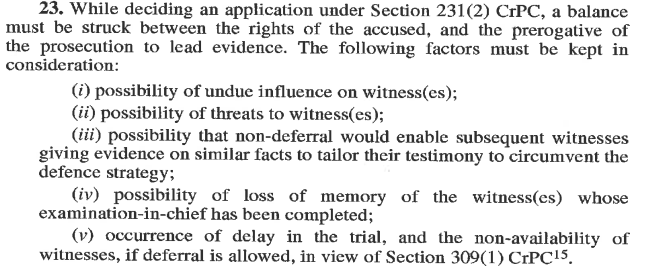
It is clear that the Court has the discretion to defer cross-examination of certain witnesses till all those witnesses are examined in chief first. On how this discretion is to be exercised, the judgment of the Supreme Court in State of Kerala v. Rasheed (2019) 13 SCC 297 is instructive. The relevant extract from the judgment is as follows:
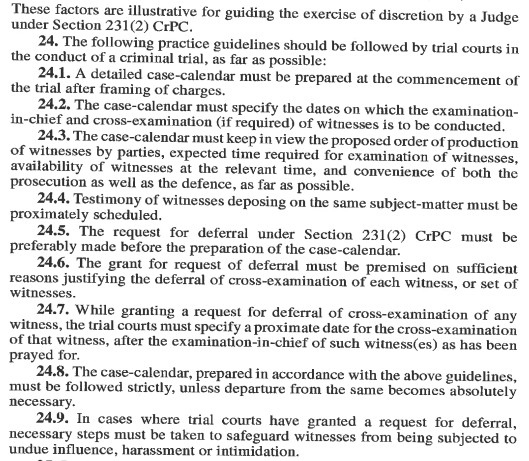
This is a very helpful tool in the armoury of a defence counsel and can be implemented in both civil and criminal trials.
Caution
Having said that, this is also not a complete panacea as very few criminal courts are able to prepare the above case-schedule and conduct trial day-to-day, and fewer still implement it.
Cross-examination of all witnesses on a single day is as rare as finding a four leaf clover.
But that, ultimately, should be the objective.
Tight, specific, razor-sharp cross examination of witnesses one after another, and preferably all on the same day, with witnesses being properly sequestered.
— Bharat Chugh
A big thank you to my colleagues Mayank and Maanish who painstakingly researched and assisted me in arguing this proposition in a few cases.


Leave a Reply